

On-Demand services have transformed the way consumers seek services. The ‘economy of convenience’ is the latest high-paying business opportunity. Here’s a data-driven plan on how you may capitalize on it. From TAM to CAGR and Impact of Technological Advancements, all the eye-openers are in this blog.
Remember ordering groceries from your local grocery shopkeeper or food from the local restaurant on call? Then waiting for hours without having any delivery updates through push-notifications and GPS trackers? And when you used call them, their owner used to tell you that the delivery boy was on the way and coming in just 5 minutes?
Well, millennials can relate to the scenario above. And if you are smiling while reading this blog, then certainly you are a millennial who has experienced this in your teenage years. But time never remains the same. With Technological advancements and rapid smartphone penetration, the ‘home-delivery’ dynamics changed forever.
Core of the Blog
With the power of on-demand services through mobile apps, which allow anytime, anywhere, doorstep delivery, consumer behaviour has shifted towards ‘convenience’ and ‘comfort’ dramatically. Eventually, retailers are also making consistent efforts to raise the bar by enhancing consumer experience and catering to their expectations through cutting-edge technology.
In this blog, we will discover how consumer behaviour is shifting with on-demand services and how web and on-demand app development services are impacting, improving, and supporting this industry. This blog will also try to discover what challenges the on-demand industry faces in Indian markets, and how technology and smart business models are overcoming these challenges.
So, if you are planning to launch your first-of-its-kind or any other kind of on-demand services, then certainly, this blog can be a treasure of relevant industry data, trends, and tips.
What Are On-Demand Services & Why Are They Popular?
Before starting with the data, it is important to understand the meaning of on-demand services. To define in simple terms, “on-demand services are a type of business model which allows consumers to book services and buy products at anytime, from anywhere, through their smartphone at their convenience, and get the product or service delivered to their doorstep within a pre-estimated timeframe.”
In order to simplify this definition further, we can break it down into the following cores-
- Anytime-Anywhere Products & Services
- Delivery At Doorstep
- Pre-Estimated Delivery Time
- Book or Buy Through Smartphone
- Enhanced consumer experience
To give real-world examples, certain mobile apps that you use every day, such as Amazon, Flipkart, Blinkit, Zepto, Zomato, Swiggy, Uber, Ola, Urban Company, etc., all belong to the on-demand services business industry.
According to a McKinsey & Company report, especially after the COVID-19 pandemic, consumer behaviour shifted dramatically.
This report states that around 75% of consumers tried new shopping methods during the pandemic era. Surprisingly, 73% of these consumers admitted that they would like to continue their shopping behaviour even beyond the pandemic.
Today, on-demand services have dominated the minds of consumers. The psychology of ‘convenience’ has changed the way consumers consume services.
Unlike the past, where consumers were dependent upon the retailer for delivery updates (which used be manipulated), today consumers get conveniently transparent, real-time, trackable, and genuine delivery updates with a promise of on-time delivery.
Then, why would consumers stick to the old ways of consumption?
Types of Popular On-Demand Services You Use Every Day
You, as a consumer, enjoy the benefits of various on-demand businesses in your everyday life through your smartphone. Broadly speaking, the major categories include:
On-Demand Home Services App
Mobile applications that you use to book on-demand home services, such as cleaning, plumbing, electricity fixing, etc., come under on-demand home services. Urban Company and KaamDaar (Jaipur Based Business) are prominent examples of this category.
On-Demand Ride Service
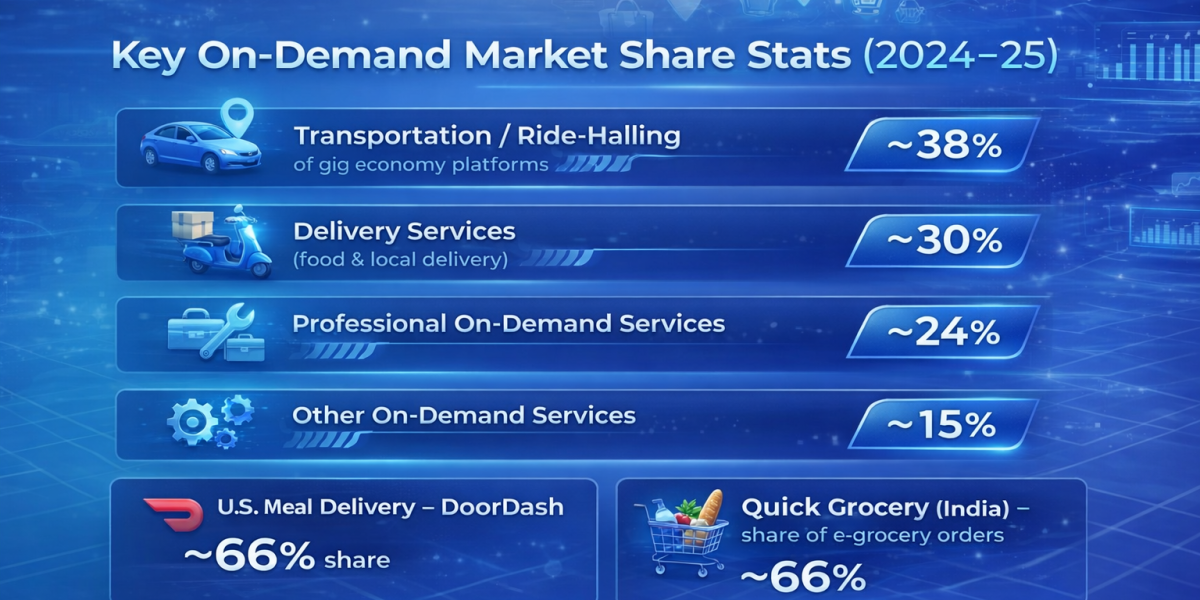
Mobile apps that allow you to book rides, cabs, taxis, shuttles, buses, etc., fall under the on-demand ride services. Uber, Ola, Rapido, Zingbus, etc., are popular examples. Globally, on-demand ride services hold the largest market share in 2025, which is 38%.
On-Demand Grocery Delivery
The on-demand grocery apps hold the second-largest market share, which is 30%. Blinkit and Zepto are the prominent examples.
On-Demand Food Delivery
The most popular category, with 30% global market share, is food delivery apps. Swiggy, Zomato, and Uber Eats are some popular examples. These business models onboarded the local restaurants and hotels to provide doorstep delivery in every area.
However, certain food chains, such as Domino’s, opted for custom or on-demand mobile app development as a strategic move to address the competition coming from local restaurants listed on such on-demand platforms.
Likewise, other on-demand categories include-
On-Demand Medicine Delivery
- Business models that deliver medicine at doorstep.
- Examples: PharmEasy and Tata One MG
Shopping On-Demand – E-Commerce Apps
- E-Commerce websites and mobile apps like Amazon, Myntra, Flipkart, Nykaa, and more.
- These on-demand e-commerce apps are like a digital marketplace that offers various types of consumer goods.
- From clothing to home decor, textiles, FMCG products, electronics, and whatnot, a consumer may find almost everything and anything on on-demand shopping apps.
Doctor On-Demand – Telemedicine Apps
- These days, telemedicine apps are also coming to the limelight since the time of the pandemic.
- Such apps allow the user to find and book appointments with doctors online and consult via video call.
- Currently, Practo is a renowned example of doctor-on-demand services.
On-Demand Salon Booking
- The beauty industry is also raising the bar of customer experience by providing salon-at-home services.
- Yes, Madam, and also Urban Company provides on-demand salon booking.
The Global Market Growth: How On-Demand Service Business Models Are Becoming A Hot Business Opportunity Worldwide?
According to Statista, the eService market, or we can say, the on-demand service market, is a trillion-dollar economy. The food delivery sector alone is projected to reach US $1.54 trillion in 2026.
Additionally, during 2026-2029, the Compound Annual Growth Rate (CAGR) has been estimated to be 7.33%.
This can result in the market volume of US $2.18 trillion by 2029 in the on-demand service industry. China will have the largest market share in the revenues.
Clearly, the on-demand service industry is showing a steep growth in revenues and market share.
Certainly, an aspiring founder who is planning to launch a mobile app in the on-demand niche can be a part of this trillion-dollar on-demand economy if his/her business model solves a genuine problem for the users.
For genuine business ideas, the on-demand services market is a hot business opportunity worldwide.
Understand The Key Growth Drivers of the On-Demand Service Market Carefully
To understand this business model carefully, it is pivotal to understand the consumer behaviour and why it is shifting. When you understand the growth drivers and ‘the psychology of convenience’, you may plan your business model and app features more smartly.
So, the factors that are leading to the growth of on-demand services include-
- Rapid Smartphone Penetration With Affordable Models
The smartphone penetration rate is very high worldwide. With special reference to India, affordable smartphone brands such as RedMe and Vivo, even the low-income groups have smartphones.
- Time-Saving Doorstep Convenience in the Fast-Moving World
On-demand services provide a doorstep delivery experience. It saves the consumer from the mental and physical toil of roaming in the crowded marketplaces. Also, it saves the time of consumers in the fast-moving world, where every minute counts.
- Live & Transparent Updates, No Manipulations
In on-demand mobile service models, the consumer has access to the live delivery status through GPS integrations. Real-Time push notifications (when enabled) provide time-to-time delivery updates.
The consumer is aware exactly when the order will reach his/her doorstep. Then why would you face false promises and manipulations?
- Large Variety to Choose From
The on-demand service models in every category, let’s say food, salon-at-home, e-commerce, or ride booking, have a wide range of options to choose from.
The user is free to find multiple vendors, a wide variety, and a flexible price range for the required goods or services. This offers a more convenient buyer experience.
- Broad Filters
Furthermore, in the online marketplace, the consumer is not ‘pursued’ by any representative unnecessarily to make a purchase.
The consumer may filter products and services on the basis of different criteria such as price, colour, brand, delivery time, and more.
Unlike how the millennials were manipulated by the shopkeeper to buy a different product in earlier times.
- Vast Price Range
On-demand service websites and mobile apps allow the consumer to set a price range and find products as per his/her convenience. Which is the biggest add-on for the consumers?
- Hassle-Free Payments with Digitalization
Ever since the digital payment system has evolved, consumers and service providers are free from the headache of finding ‘change’. Even if the payment due is INR 100.99/-, UPI payments have simplified the transfer.
- Growing GIG Economy Trend Worldwide
Post-pandemic, even the workers’ behaviour has shifted in a dramatic way. When the world has evolved to freelance, hybrid, and remote work cultures, workers like to be a part of the gig economy.
‘GIG’ is an informal term used for short-term jobs. It offers flexible job hours, flexible pay (earn as much as you work), and creates more job opportunities, indirectly combating the state of unemployment.
With the growth of the GIG economy trend, even workers love to provide service on-demand. Today, electricians, plumbers, beauty professionals, doctors, and almost any professional service provider can easily find work anytime, anywhere from their smartphone. Isn’t that great?
Therefore, we can say that on-demand service models are convenient not only for the consumers but also for the service providers. Eventually, this market is growing at such a remarkable rate.
Total Addressable Market (TAM) of On-Demand Services: How Much Market Can You Grab?
The Total Addressable Market (TAM) is the total revenue generation opportunity for a business if it reaches (and converts) 100% of its target audience. Simply put, the maximum possible market size a business may achieve.
HTF Market Intelligence, a renowned global market research and consulting firm, estimates that the global on-demand services industry can expand up to USD 4.2 trillion by 2033, due to the ‘convenience-factor’ among consumers, as we have discussed in the section above.
With a trillion-dollar TAM and 7%+ CAGR, the on-demand services industry stands as a promising business opportunity for millions of aspirational entrepreneurs.
Technology Becoming the Backbone of On-Demand Service Models
Certainly, technology is the backbone of the on-demand services industry. Behind the hassle-free consumer experience, complex technologies work. Mobile apps and web technologies are the heart and soul of the on-demand services industry. Let’s understand them in more detail-
Core Technologies Used to Support On-Demand Services
On-Demand Applications
User-friendly mobile apps, websites, and web apps allow users to find, book, and buy products and services. The users can also track the status in real-time.
Cloud Infrastructure
On-demand service apps and websites have a large user base. Let’s say Amazon, used worldwide, has data on billions of people. Cloud infrastructure makes it easy for the service providers to store, manipulate, retrieve, and scale such vast datasets securely and effortlessly.
Artificial Intelligence and Machine Learning
AI and ML technologies serve as a 24×7 hour business assistance for the service provider and a personalised sales executive for the consumer. It collects crucial consumer data to help the service provider. Simultaneously, it provides personalized recommendations to the consumer for a better experience.
GPS and Real-Time Tracking
Location-based services help the delivery partner to reach the right location within the set timeframes, smartly avoiding traffic. Likewise, the consumer may track the order in real-time and stay updated.
Payment Gateways and FinTech Integration
The consumer can pay for the on-demand services through secure payment gateways using credit cards, debit cards, net banking, and UPI methods. Almost every on-demand service offersa Cash on Delivery (CoD) option as well for greater convenience.
Data Analytics and Business Intelligence
Analytics tools integrated into the on-demand service apps provide detailed insights into user behavior, operational efficiency, stock levels, inventory, and market trends. Eventually, the on-demand service business owner enjoys well-organized market data and works in a more streamlined way.
Cybersecurity and Compliance Systems
All the on-demand services apps follow the standard cybersecurity and compliance standards. They are strongly encrypted, and third-party integrations such as payment gateways are highly reliable.
Login requires multi-factor authentication (MFA) and OTP-based transactions. Eventually, they offer a cyber-secure user experience.
Challenges That Are Obstacles for the On-Demand Industry & How Industry Leaders Overcame Them Meaningfully
Implementing on-demand services is not as easy as it might seem. Especially, in India, when it comes to Tier 1 Cities like Delhi NCR and Mumbai, things are a hundred times better than Tier-2 and Tier 3 cities. The implementation in the rural and remote areas is even more pathetic.
- Tier 2 cities like Jaipur, Indore, Lucknow, Chandigarh, Kochi, Coimbatore, Surat, Bhopal
- And Tier 3 cities like Alwar, Sikar, Barmer, Gorakhpur, Nanded, and Chhindwara
- Rural areas like distant villages in Uttarakhand
Have an altogether different scenario. Implementation of on-demand services business models in such cities and villages goes through concrete challenges like:
#1 Network Latency
Tier 2 and 3 cities and rural areas suffer from poor network issues. In such cases, booking on-demand services via smartphone becomes a challenge. Industry leaders like Zomato and FlipKart came with lightweight mobile apps that are compatible even with 3G and 2G networks.
#2 GPS Inaccuracies
Integrating Google Maps sometimes makes the mobile apps heavy to use. To combat this situation, industry leaders like Uber adopted a low-data map optimization technique. Maps developed with low-data map optimization technology are compatible to work even in low-network scenarios.
#3 Online Payment Hesitations
Attitudinal barriers related to online payments in rural areas and tier-2 cities were also an obstacle for the on-demand services industry. To overcome this challenge, all industry giants offered Cash on Delivery (COD) options and unlocked higher sales in these areas.
#4 Low Smartphone Literacy
Now, coming to the middlemen involved in the on-demand service business model. The delivery partners (or drivers in the on-demand cab booking industry) often suffer low-literacy rates.
Eventually, the difficulty in using complex mobile app interfaces by these middlemen was also a big challenge.
However, companies survived this challenge with a simple user interface (UI/UX) design that allows task completion within 2-3 clicks.
Additionally, multi-lingual support for non-English users also worked like magic for these industries.
Furthermore, Uber sets a benchmark by providing video training to the on-boarded drivers on how to use the app.
#5 Product Quality Concerns
The online e-commerce industry had another attitudinal barrier to overcome. And these barriers were not limited to Tier 2, 3, and rural areas. Rather, even Tier 1 cities were more concerned about it. This barrier was a quality concern.
Consumer thinking: What if the product I order is not up to my expectations? The e-commerce industry introduced hassle-free return and exchange policies.
#6 Linguistic Barriers in Tier 2 & 3 Cities & Rural Areas
Certain regions like the South Indian regions and Easterns parts of India are regional language-dominant areas. Many villages and even cities do not speak English or even Hindi. Companies like Amazon came up with regional language support and reached every corner without linguistic barriers.
#7 Infrastructure Barriers in Remote Areas
Remote areas with faraway and distant local stores, restaurants, and shops with poor roads were the biggest challenge for the on-demand service app industry.
However, home services business models like at-home labour and professional booking might still be struggling to overcome, E-commerce giant Amazon is combating this situation by establishing local warehouses and partnering with logistics partners serving such areas.
#8 Data Security Concerns
For a cybersecure user experience, industries leverage technologies like end-to-end encryption, multi-factor authentication, secure payment integration, Role-Based Access Control (RBAC), biometric authentication, and various other advanced features.
Parting Thoughts
So, with a promising TAM, a strong CAGR, and an evidently steady market growth, the on-demand services industry stands as a trillion-dollar economy. The business opportunities in this sector are vast and backed by amazing technologies. Not only Tier 1 cities, but also Tier 2, Tier 3 cities, and rural parts of India have an existing market with potential growth. With smart and user-friendly web and mobile app development and advanced technologies, it is simple to combat the associated risks of network latency, GPS inaccuracies, and even attitudinal and linguistic barriers among the users. So, aspirational founders must try to plan to build an on-demand app. Maybe by 2033, your app idea will become a trillion-dollar business!
