
Today, every business founder hears and talks about AI software development. Whether an IT company founder is dealing with clients or a client approaching a custom software or app development company. AI is no longer a trend or buzzword; rather, it is the core foundation of every digital product being engineered.
However, every client and consumer wants AI in every digital product, yet only a few have a clear understanding of its utility, necessity, and capabilities. In this blog, we are decoding what AI software development is, how it works, where businesses use it, and who it is beneficial for. So, let’s scroll down and take a deeper dive.
What Is AI Software Development?
AI software development is the process of designing, developing, deploying, and maintaining software applications that use artificial intelligence to perform tasks that require human-like intelligence, such as learning from data, recognizing patterns, making predictions, understanding natural/human language, or making decisions.
Unlike traditional software solutions that only ‘manage’ data and require humans to perform repetitive, mundane tasks like manual data entry, AI-powered software solutions are autonomous and can function independently.
Technically speaking, traditional software solutions follow rigid and static rules and logic. Like ‘if condition A happens, then execute function B.’ However, on the contrary, AI-powered software solutions learn from data and experience and make decisions like humans.
Traditional Software Vs. Modern AI Software Development
| Traditional Software | AI Software Development |
| Rule-based Logic: If ‘A’ happens, then perform ‘B’. Example: If order value is over $100, then apply a 10% discount automatically. | Learns From Data: Analyzes behavioral patterns and makes informed decisions. Example: If a customer shops for only luxe brands, then recommend luxe brands only. |
| Predictable Outputs: For the same inputs, outputs are always the same. Example: Consider a chatbot that gives you selected 3-4 options in every chat, and replies are pre-defined. Like choose 1 if you want to receive a call back. | Output Improves over Time: It continuously learns from new data and improves its outputs. Example: Generative Engines like ChatGPT and Gemini collect detailed feedback for every response they generate to every user query. |
| Manual Decision Rules: A traditional software product can make decisions only when they are predefined. Example: If a user enters the wrong password 3 times, lock the system for the next 5 minutes. | Data-driven Predictions: AI-powered software solutions do not follow predefined rules, but predict smart responses based on historical data. Example: An anomaly detection feature in modern logins. When the system detects a login from a different IP or an insecure network or at odd timings, it demands further verification. |
| Limited Adaptability: A traditional business process management software has to be updated every time the business process updates. Example: A new step introduced in a business process, the software system requires additional coding and programming. | Continuously Optimized with New Data: Smart AI-powered systems build on Retrieval-Augmented Generation (RAG) and do not require coding from scratch every time a process changes. Data feeding is enough. Example: AI-powered knowledge base management systems. As an organizational policy changes and the organization uploads updated documents on its ERP systems, the knowledge base updates automatically. |
Core Components of AI Software Development
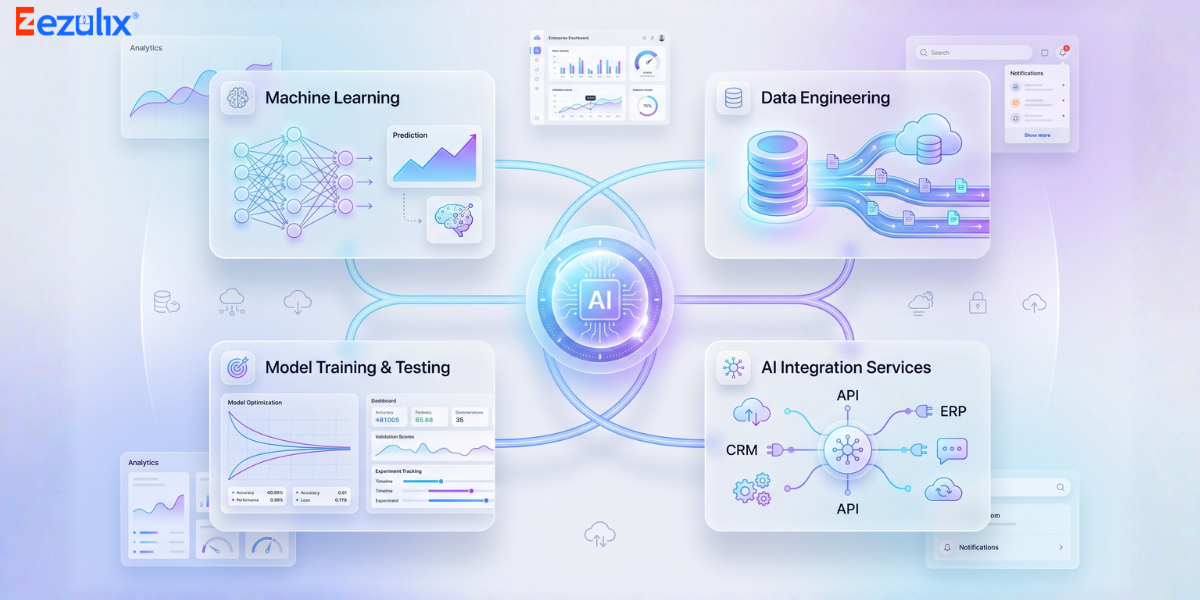
AI software development requires building a specialized architecture with specific engineering disciplines and multiple technologies. These include:
Machine Learning Development
- Machine Learning (ML) technology is the core foundation of Artificial Intelligence. In the Machine Learning Development process, an engineer ‘trains’ the algorithms by fine-tuning them with reliable ‘datasets’.
- Also, the role of Machine Learning is critical in AI software development as it enables AI to:
- Process Data
- Learn From Historical Data
- Recognize Patterns
- Analyze Behavior
- Predict Outcomes, and
- Continuously Upgrade Its Performance
- Like a teacher educates students with textbooks and helps them gain intelligence, an ML developer trains systems to learn from data and help them gain Artificial Intelligence (Intelligence which is human-like but demonstrated by machines and not humans).
Data Engineering & Data Pipelines
- Every AI engineer would say – An AI tool is as good as its data – which is absolutely true. Reconsider the student analogy shared above. When a student learns from a detailed textbook, such as a guide, he/she is likely to learn more and score higher. On the contrary, when a student learns from a crash course book, such as a key, he/she is likely to gain half knowledge – dangerous enough.
- Similarly, when an AI model learns from clean and well-organized data, it gives highly accurate outputs. Therefore, through reliable and secure data pipelines, a data engineer implements accurate data, consistent formatting, and updated information in an AI model.
Model Training & Testing
- An AI model learns from massive datasets. Therefore, an AI engineer exposes the AI model to a large quantity of datasets and trains the algorithms to recognize patterns and learn to produce outcomes from them.
- For example, social media platforms ‘recognizing’ obscene content to remove it from the platform. An engineer would first expose the platform during its development to a variety of obscene content to help it identify its traits.
- After feeding a model with large datasets, an engineer would test the model by presenting similar data (not shown earlier) to the system and checking if it performs the required action.
AI Integration Services
- One big myth that most businesses looking for AI-based solutions believe is that they need to get an AI software solution developed from scratch. But that’s not true. By integrating AI capabilities directly into legacy CRM systems, ERP platforms, mobile apps, web applications, customer portals, and business intelligence dashboards.
- Building from scratch is never our first suggestion. Rather, AI integration services can help a business save up to 60% of development cost and over 80% of development time.
Types of AI Software Businesses Built Today
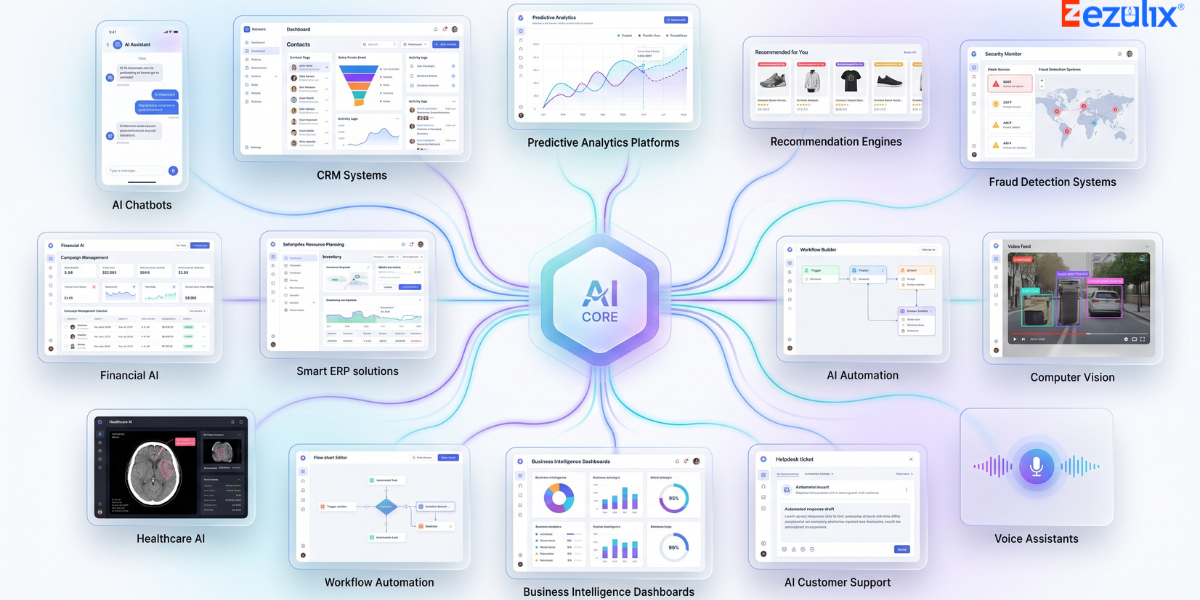
Today, AI has dominated every business industry and all walks of life. The most common type of AI software solutions that every AI development company usually builds include:
Predictive Analytics Tools
Tools that recognize patterns from historical data and forecast outcomes. Say, for example, smart equipment failure prediction systems and inventory management tools.
Recommendation Engines
Tools that analyze behavioral patterns and recommend content, products, services, and suggestions that align with users’ preferences. For example, social media and eCommerce platforms like Instagram, YouTube, and Amazon.
RAG-Based Knowledge Management Systems
Tools trained with organizational data and backed by large language models (LLMs) for generating context-aware answers. For example, a tailored HRMS that can quickly retrieve the leave policy documents and let an employee know his/her leave balance.
Robotic Process Automation (RPA) Systems
For document process automation, a top custom software development company in the AI niche implements IDP technologies like Optical Character Recognition (OCR), Natural Language Processing (NLP), Computer Vision (Image recognition), Optical Mark Recognition (OMR), Intelligent Character Recognition (ICR), etc. for hyperautomated documentation.
Computer Vision Applications
Tools that can recognize visual data such as images and videos to interpret objects, spatial conditions, and anomalies. Say, for example, quality inspection tools, medical image analyzers, face recognition systems, etc.
Natural Language Processing (NLP) Tools
Tools that can read, interpret, analyze, and generate human language in a meaningful way. The biggest examples are popular generative engines these days – Google Gemini, ChatGPT, Perplexity, and Claude that can understand human language and produce requested output.
How the AI Software Development Process Works
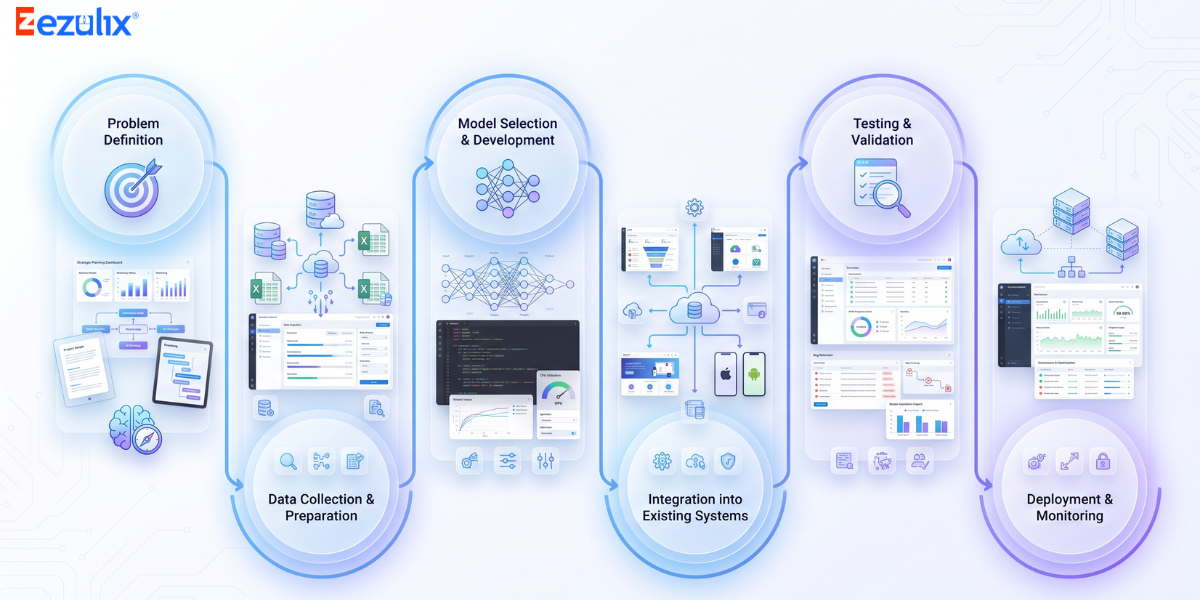
Building an AI solution requires a step-by-step systematic roadmap. If a business is opting for AI software development services, then it must follow a path like:
1. Problem Definition & Feasibility Assessment
Rather than jumping to AI product development under FOMO, a business must first start by finding its feasibility for itself. Clearly define what specific business problem you are trying to solve with AI. Say, for example:
- ❌ Saving X hours by implementing AI.
- ✔️ Eliminating manual data entry from the billing process by implementing AI.
Analyze feasibility by asking yourself: if the AI implementation aligns with your organizational budget, what specific ROI will it deliver post-implementation, and do you have sufficient data to train the model?
2. Data Collection & Preparation
When AI implementation seems feasible, the AI development company starts with data collection from relevant sources like Databases, ERP systems, CRM platforms, APIs, IoT devices, Customer interactions, and more. The team cleans data by removing duplicates, handling missing fields, and formatting the data for model ingestion.
3. Model Selection & Development
Then, the AI development team chooses a suitable development model and technology stack that best aligns with your business goals. For example, choosing from Machine Learning, Deep Learning, LLM Fine-tuning, Computer Vision, and more.
4. Integration Into Existing Systems
A modern AI software development company would first look for API-first AI integration into your business. Eventually, it will integrate the AI feature into your existing systems. If not feasible, it will build an AI solution from scratch and will integrate AI into your workflows, automating processes for frictionless execution.
5. Testing & Validation
Before deployment, an AI model undergoes rigorous testing procedures. Until it demonstrates a glitch-free, bias-free, and compliance-friendly performance, it is not deployed for end use.
6. Deployment & Monitoring
Once the AI model/feature passes all the quality standards, the software development team deploys it and continuously monitors its performance. Also, a reliable AI development company prefers to support an organization with ongoing maintenance, routine check-ups, and on-time AI upgrades.
Who Needs AI Software Development?
Artificial Intelligence automates repetitive tasks, significantly reducing time and effort consumed in a process. However, not all businesses require AI integration in their workflows, but certain signs indicate that you need AI-powered solutions. These signals include:
- Your team spends more than 60% of business hours in repetitive, mundane tasks such as data entry.
- The business processes are well-defined and least dynamic. Such processes are easier to automate with AI.
- When an off-the-shelf software solution does not fit in, and it seems you are adapting your workflow to a software, rather than the software adapting to your workflows.
- The operational hours, efforts, and cost are increasing simultaneously.
- Predictive analytics feels like a necessity due to frequent system breakdowns and equipment failures.
Industries that Need AI
Furthermore, there are some industries for whom AI is non-negotiable. These include:
- Healthcare: Physicians can get rid of massive documentation and administrative work with the help of AI healthcare software development.
- FinTech: The FinTech industry deals with large data, frequent repetitive work, and sensitive information. With AI, it can automate fraud detection, credit risk assessment, compliance monitoring, and algorithmic trading.
- eCommerce: The eCommerce industry can deliver a hyper-personalized shopping experience. From an optimized customer experience to streamlined inventory and supply chain management, AI in eCommerce development has become a crucial part.
- Supply Chain & Logistics: For the supply chain and logistics industry, AI can significantly reduce the order fulfilment time while also saving operational costs with smart route optimization, fuel management, and predictive maintenance.
- Education: AI is enhancing learning experiences through personalized recommendations for students. It also frees the tutors from manual administrative workloads.
- Manufacturing: The manufacturing industry, which produces in large amounts, can reduce wastage and speed up quality inspections by implementing computer vision.
In-House Team vs. AI Development Company
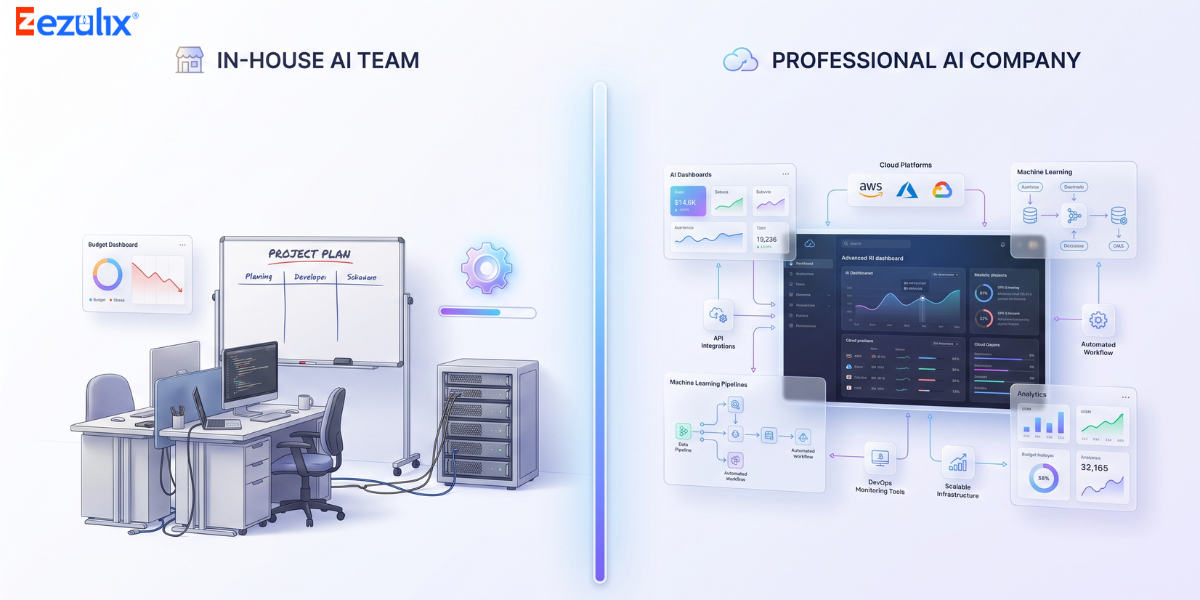
- Hiring an in-house team for AI software development is a complex process. It often requires huge capital investment, time, and patience. For building AI solutions, a business might need to hire experienced-
- AI Engineers
- Machine Learning Engineers
- Data Engineers
- Data Scientists
- MLOps Engineers
- UI/UX Designers
- Custom Software Developers
- Project Mangers
Clearly burning a big hole in the pocket, not once, but every month (salaries, benefits, & allowances).
- Therefore, most businesses prefer to partner with an AI development company instead of hiring in-house. The AI companies have an existing, reliable pool of talent accessible at a one-time price. Partnering with a company significantly reduces operational costs, accelerates project delivery, and offers scalability. It offers in-house support without the pain of hiring an in-house team.
Benefits of AI Software Development for Businesses
Businesses that adopt AI experience measurable improvement in their operational excellence. Some remarkable benefits of AI software development for businesses include:
- Faster Decision-Making – When a business automates its repetitive tasks, its team saves a great deal of time and energy that it can use in decision-making, strategizing, and problem-solving. Thus, decisions are not only faster but also well-informed.
- Reduced Manual Workload – Introduction of AI in the business processes encourages autonomous and intelligent workflows, considerably reducing the manual workload.
- Improved Customer Personalization – With capabilities such as behavioral analytics and sentiment analysis, Artificial Intelligence caters to customer needs faster, better, and with more efficiency. It remarkably enhances the customer engagement rate and helps generate more revenue by converting more.
- Competitive Advantage – With tailored business process automation, a business enhances its unique workflows. This automatically differentiates the performance from the competitors using off-the-shelf software solutions.
Common Misconceptions About AI Software Development
The thought of AI transformation comes with various myths and misconceptions, of which the top 3 myths about AI transformation among businesses include the following. Let us now try to validate them:
Myth #1 – “AI is Only for Big Enterprises”
Absolutely false! Whether large enterprises or Small and Medium Businesses (SMBs), AI is inseparable from workflows in the present-day scenario. In fact, small organizations such as startups with limited resources must mandatorily invest in AI-powered tools for faster production with fewer resources. Large enterprises often have 5+ humans to perform the same task, but small organizations have 5 tasks to perform with 1 human.
Myth #2 – “AI Development is Expensive”
Partially false, and partially true. The cost to develop an AI-powered software solution depends upon the scope of work (SoW) and overall project complexity. However, it is not necessary that custom AI software cost goes on the high side always. If choosing API-first and modern MVP development & integration techniques, AI software development costs moderately.
Myth #3 – “Any Developer Can Build AI Features”
Totally false! Just like any other kind of software developer, an AI engineer has a specific technology stack and skill set. For AI software development, your chosen developer must have knowledge and experience in the following technology stack:
- Programming Languages: Python, R, Java
- Machine Learning Frameworks: TensorFlow, PyTorch, Scikit-learn
- Generative AI & LLMs: OpenAI, Anthropic Claude, Google Gemini, Llama
- AI Frameworks: LangChain, LlamaIndex, CrewAI, AutoGen
- Vector Databases: Pinecone, Weaviate, ChromaDB, Milvus
- Databases: PostgreSQL, MongoDB, Redis
- Cloud Platforms: AWS, Microsoft Azure, Google Cloud Platform
- MLOps & Deployment: Docker, Kubernetes, MLflow, Vertex AI, SageMaker
- Data Processing: Pandas, NumPy, Apache Spark
- APIs & Backend Development: FastAPI, Flask, Django
- Version Control & CI/CD: Git, GitHub Actions, Jenkins
- AI Security & Governance: Prompt security, model monitoring, guardrails, data privacy, and responsible AI practices
Additionally, the developer must have a strong foundational knowledge in Data Engineering, Applied Mathematics & Statistics, and AI software lifecycle management techniques.
Frequently Asked Questions (FAQ)
AI software development in simple terms means engineering smart or intelligent software solutions that can demonstrate human-like intelligence – learn from data (Machine Learning), read (Natural Language Processing), understand (behavior analytics), converse (Speech to Text & Text to Speech), see (computer vision), sense (sentiment analysis), and execute required tasks autonomously without requiring much human intervention.
Regular software development focuses on writing static rules and logic that fix predictable responses (outputs) for particular inputs. On the contrary, AI software development focuses on engineering smart solutions that can demonstrate human-like cognition. AI-powered software solutions can analyze data and provide synthesized outputs.
Fintech, Healthcare, eCommerce, Education, supply chain, logistics, and manufacturing industries are majorly adopting AI solutions due to large-scale production and heavy manual work-load.
Yes. Absolutely. Small businesses have limited financial and human resources. Artificial Intelligence can execute various business operations autonomously 24/7 without any fatigue. Eventually, AI is one-time investment for small businesses. It helps small businesses enhance production without increasing operational costs.
Strong foundational knowledge in Data Engineering, Applied Mathematics & Statistics disciplines and proficiency in AI technology stack including, Python, R, and Java programming languages, Machine Learning Frameworks like TensorFlow, PyTorch, Scikit-learn, Gen AI tools such as OpenAI, Anthropic Claude, Google Gemini, Llama, and AI development Framekworks such as LangChain, LlamaIndex, CrewAI, and AutoGen.
If your team is still spending 40–60% of its business hours on repetitive tasks such as data entry, document processing, report creation, customer support, or invoice management, it may be time to invest in AI software development. Likewise, if your business has a large knowledge base that’s difficult to search, or employees spend too much time finding information instead of using it, AI can significantly improve productivity and decision-making.
Conclusion
AI software development is no longer experimental, neither it is just a buzzword. Rather, it is a necessity for every business to catalyze production and improve customer engagement. AI is the key foundation for modern business process management.
It is empowering the human resources with automated workflows that can significantly reduce their fatigue and enhance accuracy in work.
Businesses are leveraging improved operational efficiency, speed in execution, and informed decision making with the power of AI.
However, choosing the right AI software development company is crucial to find the best AI implementation tailored to your business needs.
The right AI partner can automate your business processes for higher efficiency. On the contrary, an inappropriate partner can increase your technical and financial overhead with the wrong or mismatched solution.
