
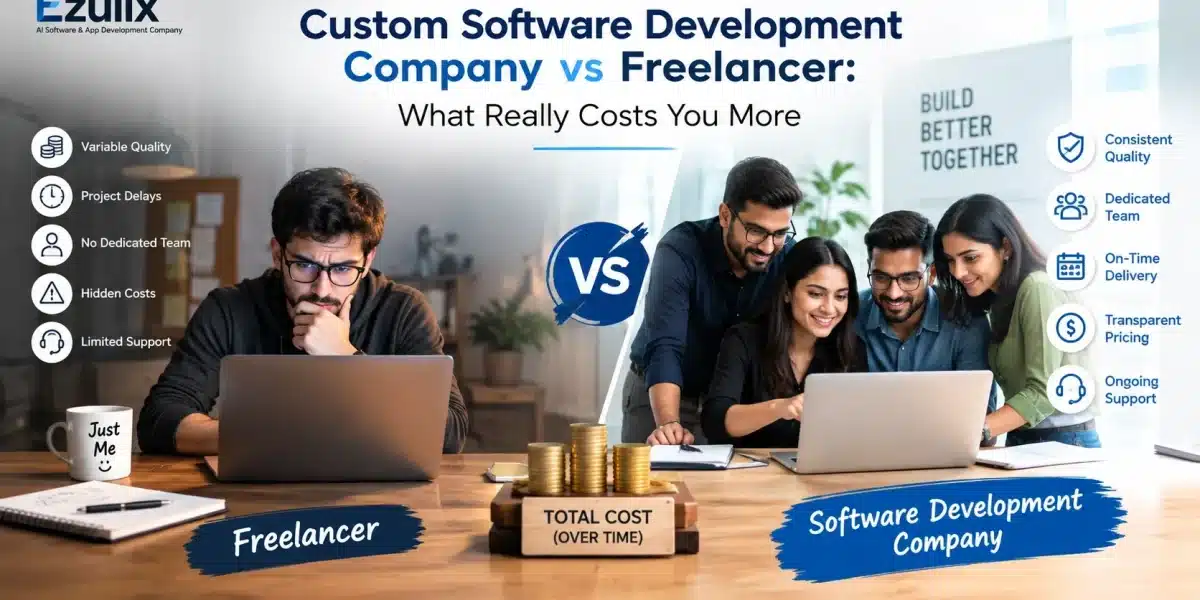
A freelance developer usually costs 40–60% less per hour than a custom software development company. For projects under roughly ₹3–5 lakh with a clear, fixed scope and no compliance requirements, that saving is real and you should take it.
Above that threshold, the arithmetic tends to reverse. The cost that matters is not the hourly rate — it is the total cost of ownership across the project’s life, which includes rework, delays, knowledge loss when a developer leaves, security remediation, and the cost of rebuilding software that wasn’t architected to grow. On a two-year horizon, the cheaper hourly option frequently ends up being the more expensive one.
The honest framing is not “which is better.” It is “at what project size and risk level does the cheaper hourly rate stop being cheaper?” This article answers that with numbers.
How the hourly rates actually compare
Indicative rates for the Indian market in 2026. Treat these as ranges to sanity-check quotes against, not as fixed prices — rates vary significantly by city, technology stack and seniority.
| Freelance developer | Small agency / studio | Established development company | |
| Hourly rate (India) | ₹500 – ₹2,500 | ₹1,000 – ₹2,500 | ₹1,500 – ₹4,000 |
| Typical monthly cost (full-time equivalent) | ₹80,000 – ₹3,00,000 | ₹1,80,000 – ₹4,00,000 | ₹2,50,000 – ₹6,00,000 |
| What the rate includes | One person’s coding time | Developer, partial PM | Developer, QA, PM, DevOps, designer, architect |
| Who does testing | Usually the same developer | Sometimes a dedicated QA | Dedicated QA function |
| Who covers absence | Nobody | Sometimes | Contractual bench |
The critical line in that table is the fourth one. A freelancer’s rate buys you coding hours. An agency’s rate buys you coding hours plus the surrounding functions — requirement analysis, design, testing, deployment, project management — which on a real project consume 40–50% of total effort regardless of who performs them.
If a freelancer is doing all of those roles, they are either doing them at the expense of coding time, or not doing them at all. Both outcomes have a cost; it just doesn’t appear on the invoice.
Where the real cost hides: total cost of ownership
Comparing quotes is comparing the visible 60% of the project. Here is the rest.
Rework and defect cost
The industry’s most durable finding is that defects get more expensive the later they’re caught. A requirements error caught during design costs a fraction of what it costs once the software is in production. Without a dedicated QA function and a review process, more defects survive to production.
For a mid-sized project, budget realistically for 15–30% rework effort when there’s no independent testing layer, against 5–10% when there is. On a ₹10 lakh project, that difference is ₹1–2 lakh — roughly the entire saving from choosing the lower hourly rate.
The continuity problem
This is the single largest financial risk in freelance engagements, and it’s rarely priced in.
If a solo developer takes another contract, falls ill, or simply stops responding, your project stops. Worse, the knowledge of how the system works stops with them. Onboarding a replacement onto undocumented code written by someone unavailable for questions typically costs 30–50% of what the original build cost — and takes weeks you hadn’t planned for.
Companies carry this risk on their own balance sheet. That’s a substantial part of what the margin in their rate is actually buying.
Integration and architecture debt
Software built quickly by one person tends to be built for the requirements in front of it. That’s efficient, until you need to add a second user role, integrate a payment gateway, support 10,000 concurrent users, or expose an API.
Retrofitting architecture is dramatically more expensive than designing for it. The most common expensive outcome in small-business software is not a failed project — it is a successful project that has to be rebuilt in year two because it can’t grow.
Security and compliance remediation
If your software touches payment data, health records, student data, or personal information of EU or UK residents, compliance is not optional and it is not cheap to add afterwards. A security audit that finds structural problems can require changes that cost more than the original build.
Your own time
The least-counted cost. Managing a freelancer directly means you are the project manager, the QA, and the requirements analyst. If you’re a founder billing your time at anything meaningful, ten hours a week of coordination over six months is a real number — often ₹2–4 lakh of opportunity cost that never appears in any comparison.
Worked scenarios: when each option wins
Scenario 1 — A marketing website with a booking form
Scope: 8 pages, one form, payment link, no user accounts.
Freelancer: ₹60,000 – ₹1,50,000, 3–5 weeks.
Development company: ₹2,00,000 – ₹4,00,000, 4–6 weeks.
Verdict: freelancer. The scope is well-understood, the failure mode is cheap, and a rebuild would cost little. Paying agency overhead for this is paying for risk management you don’t need.
Scenario 2 — An internal inventory and billing system for a 40-person business
Scope: Multi-user, role permissions, GST-compliant invoicing, reporting, Tally integration.
Freelancer: ₹3,00,000 – ₹6,00,000 quoted, realistically 5–9 months.
Development company: ₹8,00,000 – ₹15,00,000 quoted, 4–6 months.
Verdict: genuinely contested. The freelance quote is lower and can work — if you find a strong developer who stays, you manage the project actively, and the scope doesn’t expand. Factor in a realistic 25% rework allowance, the value of your own management time, and the replacement risk, and the gap narrows to something like ₹6–8 lakh against ₹10 lakh. You are paying roughly 30% more for materially lower variance. Whether that’s worth it depends on how much a three-month delay costs your operations.
Scenario 3 — A customer-facing fintech platform with KYC and payments
Scope: Mobile apps, payment gateway, KYC, audit logging, RBI-aligned data handling.
Freelancer: Not a viable option at any price.
Development company: ₹25,00,000+
Verdict: development company, without qualification. This isn’t a cost comparison. The work requires a security specialist, a compliance-aware architect, QA, and DevOps simultaneously. One person cannot hold these roles, and the downside of getting it wrong is regulatory, not financial.
The honest case for hiring a freelance developer
Any comparison that concludes agencies always win is marketing, not analysis. Freelancers are the correct choice more often than agencies admit:
- Well-defined, bounded scope. If you can write the spec in two pages and it won’t change, you don’t need a process layer.
- Specialist short tasks. A one-week performance optimisation or a specific integration is perfectly suited to a specialist contractor.
- Genuine budget ceilings. If ₹3 lakh is what exists, a freelancer building something real beats an agency proposal you cannot afford.
- You have in-house technical leadership. If your own CTO handles architecture and review, freelancers become an efficient capacity extension.
- Proving an idea before investing. A rough prototype to test demand doesn’t need production architecture.
The failure mode isn’t hiring a freelancer. It’s hiring a freelancer for work that needed a team, then discovering it eighteen months in.
Choosing a software development partner: a decision framework
Score your project honestly. Each “yes” pushes you toward a company rather than an individual.
- Will more than 500 people use this system?
- Does it handle payments, health data, or personal data under GDPR/DPDP?
- Will it need to integrate with two or more external systems?
- Would three months of downtime materially damage the business?
- Do you expect the scope to evolve during the build?
- Do you lack in-house technical leadership to review the work?
- Does the project need design, backend, mobile and DevOps skills simultaneously?
- Do you need someone contractually accountable if it fails?
0–2 yes: A freelancer is likely the efficient choice.
3–5 yes: Contested. Consider a hybrid model.
6–8 yes: A development company. The rate difference is insurance you need.
The hybrid models most businesses overlook
The choice isn’t binary, and the middle options are frequently the best value.
Paid discovery, then decide. Commission a development company for a two-to-four-week discovery — architecture, specification, wireframes, estimates — for ₹1–3 lakh. Then execute with freelancers against that specification. You buy the expensive thinking and avoid the expensive delivery overhead.
Dedicated team hire. Many firms, including software development companies in Gurgaon and across NCR, will rent you developers at near-freelance rates while retaining replacement guarantees and internal oversight. You get continuity insurance without full project-management markup.
Freelance build, agency audit. Have a freelancer build, then pay a company ₹75,000–₹2,00,000 for a security and architecture review before launch. Catches the structural problems while remediation is still cheap.
Agency core, freelance periphery. Company builds the architecture and sensitive components; freelancers handle screens, content and peripheral features at lower cost.
What to ask before you sign either one
Ask both:
- Who owns the source code and IP on completion? Get it in writing, unambiguously.
- Where will the code live during and after development?
- What happens if the work is late — what’s the remedy?
- Can I see the code repository as work progresses, not just at delivery?
Ask a freelancer specifically:
- How many other projects are you running concurrently?
- What happens to my project if you take a full-time role?
- Who reviews your code?
- Will you document the system for a future developer?
Ask a development company specifically:
- Who exactly is on my team, and are they shared with other clients?
- What’s your developer attrition rate?
- Show me the QA process, not a description of it.
- What’s the post-launch support term, and what does it cover?
- If my project manager leaves, what happens?
Frequently Asked Questions
Q. Is a freelancer always cheaper than a software development company?
Per hour, almost always — typically 40–60% less. Over a project’s full life, not reliably. Once you account for rework without dedicated QA, replacement risk, your own management time, and possible rebuild costs, the gap narrows sharply and often reverses on projects above ₹5 lakh.
Q. What does custom software development cost in India in 2026?
Broad indicative ranges: simple web applications ₹2–8 lakh; mid-sized business systems such as CRM, ERP modules or inventory platforms ₹8–25 lakh; complex multi-platform or regulated products ₹25 lakh and upward. Cost is driven by number of user roles, integrations, compliance requirements and platform count — not by page count.
Q. At what project size should I stop using freelancers?
There’s no universal line, but the practical inflection point is where the project needs more than one skill set at the same time. When you need backend, mobile, design and DevOps simultaneously, you’re coordinating a team — and coordinating a team of freelancers is a full-time job you’ll be doing yourself.
Q. Who owns the code — me or the developer?
Only whoever your contract says. Under Indian copyright law, a contractor generally retains copyright in commissioned work unless the agreement assigns it. Both freelancers and companies can be perfectly willing to assign IP; the difference is that companies usually have standard clauses and freelancers often don’t. Never begin work without written IP assignment.
Q. What’s the biggest risk in hiring a freelance developer?
Continuity. Not skill — plenty of freelancers are stronger engineers than agency staff. The risk is that the entire system’s knowledge sits with one person who has no contractual obligation to remain available. Mitigate it with mandated documentation, your own repository access from day one, and staged payments.
Q. Are development company estimates negotiable?
The rate rarely moves much; the scope almost always does. The productive conversation is “what can we remove from phase one?” rather than “can you reduce the price?” Phasing a project is usually the single largest lever on cost.
Q. How do I verify a freelancer or company is actually capable?
Ask for a reference from a client whose project is at least a year old — that reveals maintenance behaviour, not just delivery. Ask to see code from a past project, with permission. For companies, check independent review platforms and, in India, verify the registered entity on the MCA portal.
Q. Should I pay a fixed price or hourly?
Fixed price suits genuinely fixed scope and shifts risk to the vendor — who prices that risk in, so you pay a premium. Hourly or time-and-materials suits evolving scope and is cheaper if the scope is stable, but requires you to monitor. For most mid-sized projects, a fixed-price discovery phase followed by time-and-materials delivery balances both.
Q. Can I start with a freelancer and move to a company later?
Yes, and it’s common — but plan for it from day one. Require documentation, a clean repository, and standard technology choices. Migrating from an undocumented, idiosyncratic codebase costs 30–50% of a rebuild.
Q. Does hiring locally actually matter?
Less than it used to, but not zero. Working with a software development company in Gurgaon or your own city means shared time zones, in-person requirement workshops, and a registered entity you can pursue contractually in your jurisdiction. For complex or long-running projects, that accessibility has measurable value. For a simple bounded build, it doesn’t.
Q. What’s the minimum I should spend on custom software to get something usable?
Below roughly ₹1.5–2 lakh, you’re generally better served by configuring an off-the-shelf product than commissioning custom software. Budgets under that threshold rarely cover requirements, build, testing and deployment adequately, and the result usually needs replacing.
The bottom line
The real question is not who charges less per hour. It’s what it costs you if the project is late, has to be rebuilt, or stops entirely when one person becomes unavailable.
If that cost is low, hire a freelancer and don’t overpay for process you won’t use. If it’s high — because the software runs your operations, holds sensitive data, or is the product itself — the rate difference is buying variance reduction, and it’s usually worth it.
Price the downside before you compare the quotes. That single step prevents most expensive software decisions.
