
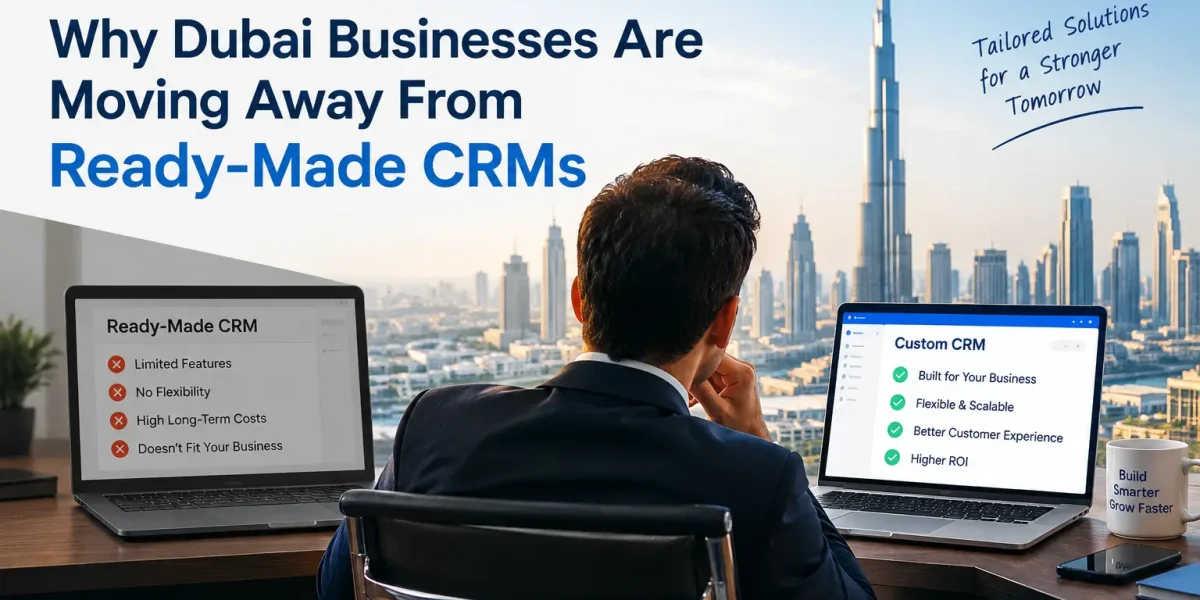
Why Dubai Businesses Are Moving Away From Ready-Made CRMs
Most Dubai companies start with a ready-made CRM. It makes sense. You sign up, add your team, and you’re running in a day.
Then things get awkward. Your sales process has a stage the tool doesn’t have. Your accounts team needs the data in a different format. Someone asks for a WhatsApp follow-up, and the only way to do it is a paid add-on. A year in, you’re paying for 60 licences and using about a third of the features.
That’s usually when a business starts looking into CRM software development. Instead of forcing your team to work the way the software wants, you build the software around the way your team already works.
[Add one or two lines from your own experience here. For example: “In projects we’ve handled for real estate and service companies, the same complaint came up again and again: the CRM was built for someone else’s process.”]
This guide covers ten companies offering custom CRM development in Dubai and the wider UAE. Each entry lists key services, the best-fit client, and one question worth asking before you sign. After the list, you’ll find a vendor scorecard you can copy, a look at costs, UAE data rules, and answers to common questions.
How We Chose and Ordered These Companies
Lists like this are only useful if you know how they were put together. We looked at each company using the same five points:
- Relevance: does the company offer custom CRM or business software development, not only websites or apps?
- Range of work: industries served, and whether they build web plus mobile.
- Integration ability: experience connecting CRMs to WhatsApp, payment gateways, accounting tools, and ERPs.
- Fit for UAE needs: Arabic and English support, regional habits, and awareness of local rules.
- Support model: what happens after launch.
Rankings reflect how broadly a company fits typical UAE CRM projects. They are not a guarantee of quality. [Add your own checking method here: reviewed Clutch and GoodFirms profiles, checked portfolios, spoke to the company, etc. State only what you really did.]
Company details change often, so confirm current services and pricing with each company directly.
What Custom CRM Software Development Really Means
A custom CRM is a customer management system built for one specific business. Sometimes it’s coded from scratch. Sometimes it’s built on an existing framework and shaped heavily. Either way, you decide what it does.
A typical build includes:
- Contact and lead records with fields that match your business
- A sales pipeline with your real deal stages
- Automated reminders and follow-ups
- A support or ticketing area
- Reports a manager can read in half a minute
- Connections to your website, accounting software, and payment gateways
In the UAE, a few extras matter more than people expect: Arabic and English screens, WhatsApp as a main communication channel, VAT-ready invoicing, and careful handling of customer data.
| Point | Ready-made CRM | Custom CRM |
| Setup | Quick | Slower, but planned |
| Cost pattern | Monthly fee per user | Build cost plus support |
| Fit for your process | Partial | Complete |
| Integrations | Limited by the vendor | Built for your systems |
| Ownership | The vendor’s product | Your code and data |
A small team with simple needs can be perfectly happy with a ready-made tool. Custom starts to win when your process is unusual, your team is growing, or licence fees begin to sting.
A Simple Way to Check If Custom Makes Sense (Illustrative Example)
Here is a rough way to think about it. These numbers are made up for illustration, so replace them with your own quotes.
Say a ready-made CRM costs AED 150 per user per month, and you have 40 users. That’s AED 6,000 a month, or AED 72,000 a year, and it rises every time you hire. If a custom build costs AED 200,000 plus AED 30,000 a year for support, the two options cross over somewhere around the third year, and the gap widens as your team grows.
This maths ignores extras like add-on modules and integration fees, which usually make ready-made tools cost more than the headline price. Run the same calculation with real quotes before you decide.
Why Custom CRM Development Fits the Dubai Market
Dubai isn’t a slow-moving market. A property enquiry that arrives at 9 pm on a Thursday needs a reply that night, not on Sunday. A custom CRM can send an instant reply, assign the lead to the right agent, and remind that agent if nothing happens within an hour.
Then there’s the mix of clients. One week you’re dealing with a buyer from India, the next a family from Saudi Arabia, then a company from Germany. Languages, currencies, and communication habits all differ.
Industry needs also vary. A clinic tracks appointments and patient history. A logistics firm tracks shipments and drivers. A real estate agency tracks listings, viewings, and commissions. It’s rare for one generic tool to cover any of these well.
Top 10 Custom CRM Software Development Companies in Dubai, UAE
1. Ezulix Software Pvt Ltd
Ezulix Software works with clients across the Middle East, including Dubai. They build web platforms, mobile apps, and business software, and CRM work fits naturally into that. One thing that stands out is pairing a web dashboard with a mobile app, which helps field sales teams who spend more time on the road than at a desk.
Their process generally starts with a conversation about how your sales team actually works. Design, development, testing, and support follow. For businesses that want a tailored system without agency-level pricing, Ezulix is worth a place on the shortlist.
Key Services:
- Custom CRM development
- Android and iOS CRM apps
- web dashboards
- API and third-party integrations
- data migration
- ongoing maintenanc
Best For: Startups, small businesses, and mid-sized companies that want a tailored CRM on a reasonable budget with a flexible way of working.
2. Code Brew Labs
Code Brew Labs is one of the better-known app and software companies based in Dubai. They’ve worked across on-demand services, retail, healthcare, and logistics. Their CRM projects usually come out looking modern, and that matters more than people admit. If the interface feels dated, your sales team will avoid it.
Key Services: Custom CRM platforms, mobile apps for sales and support teams, UI and UX design, cloud-based architecture, payment and messaging integrations, and MVP development.
Best For: Businesses that care about design and mobile experience, especially those planning a bigger digital product around the CRM.
Ask them: Can you show a CRM you built for a business at our size, not only a large brand?
3. RoyoApps
RoyoApps builds apps and custom software for startups and established brands. They tend to do well when customer data has to connect with the rest of a business: a mobile app, an online store, a booking system. If your customers book or buy through an app, having the CRM built by people who understand that app saves a lot of back and forth.
Key Services: Custom CRM and business management software, mobile and web development, e-commerce and booking integration, customer portals, cloud deployment, and technical support.
Best For: Consumer-facing startups and brands that need the CRM to work closely with their app or online store.
4. Blocktech Brew
Blocktech Brew comes from a blockchain and fintech background, and that shapes how they approach CRM projects. They’re comfortable where security, audit trails, and customer verification matter, such as trading platforms, crypto companies, and finance firms.
Key Services: CRM development for fintech and finance, blockchain-based record management, secure API work, KYC and onboarding workflows, analytics dashboards, and platform development.
Best For: Fintech, crypto, and financial services companies that need strong security and compliance-friendly workflows.
Ask them: How do you log and review who accessed or changed customer records?
5. Dubai App Developers
A locally rooted agency focused on mobile apps, web platforms, and business software for UAE companies. Being based in the market helps. They already know that clients here live on WhatsApp, that bilingual screens are often a must, and that decision-makers like to meet in person. Their CRM builds tend to be practical rather than flashy.
Key Services: Custom CRM development, Arabic and English interfaces, WhatsApp and SMS integration, sales pipeline and lead tracking, mobile apps, and regular upgrades.
Best For: UAE-based companies that want a locally aware CRM and easy communication with their development team.
Ask them: Does your Arabic interface support right-to-left layout across every screen and report?
6. Nexora Digital Labs
Nexora Digital Labs works with growing companies that want digital systems built around their operations. In CRM projects, they lean toward automation: fewer manual entries, faster lead follow-ups, cleaner reports. They suit teams that already know what’s slowing them down.
Key Services: Custom CRM systems, workflow and marketing automation, lead capture and scoring, email and WhatsApp campaign tools, dashboards, and migration from older platforms.
Best For: Sales-driven businesses that want automation to cut repetitive work and speed up follow-ups.
Ask them: Which automations do you recommend building first, and which should wait?
7. VertexNova Technologies
VertexNova Technologies focuses on mid-sized and larger clients, with an emphasis on systems that can grow. If you have several branches, multiple departments, or approval chains involving more than two people, this is the kind of company that tends to be comfortable with that complexity.
Key Services: Enterprise CRM development, multi-branch access control, ERP and accounting integration, custom reporting, cloud or on-premise deployment, and long-term support contracts.
Best For: Larger organisations with multiple teams or locations that need a well-structured, scalable CRM.
Ask them: What is the largest number of users and records a system of yours has handled?
8. LuminaTech Solutions
A CRM is only useful if people open it every day. LuminaTech Solutions builds with that in mind. Their work leans toward clean dashboards for managers and simple screens for the sales team, so nobody needs a manual to log a call.
Key Services: Custom CRM development, dashboard and data visualisation, support and ticketing modules, third-party integrations, user training, and post-launch improvements.
Best For: Companies that have tried a CRM before and watched their team ignore it.
Ask them: How do you test screens with real sales staff before development is finished?
9. FusionStack Studio
FusionStack Studio builds web and mobile solutions for businesses of different sizes. In CRM projects, they like to fold several tools into one. Sales tracking, support, invoicing, and project management can live in a single system, which is a relief if you’re jumping between four or five apps.
Key Services: All-in-one CRM and business management systems, invoicing and payment tracking, project and task modules, API development and integration, web and mobile apps, and maintenance.
Best For: Agencies and service businesses that want to replace a pile of separate tools with one custom platform.
Ask them: How will you keep an all-in-one system from becoming slow or cluttered as we add modules?
10. OrbitNest Technologies
OrbitNest Technologies works mostly with small and medium businesses, and their CRM projects are usually delivered in phases. You begin with the core features, such as contacts, leads, and deals, then add more once you’ve seen how the team uses the system. It’s a calmer way to spend money and lowers the risk on a first custom project.
Key Services: Phased CRM development, MVP builds, contact and deal management, basic automation, website and app integration, and support plans.
Best For: Small businesses and first-time CRM buyers who want to start lean and expand later.
Ask them: What exactly is included in phase one, and what would phase two cost?
Quick Comparison
| Rank | Company | Known For | Ideal Client |
| 1 | Ezulix Software Pvt Ltd | Web and mobile CRM at a fair price | SMEs and startups |
| 2 | Code Brew Labs | Design-led products | Brands wanting a polished CRM |
| 3 | RoyoApps | App-linked systems | Consumer-facing startups |
| 4 | Blocktech Brew | Secure, finance-focused builds | Fintech and crypto firms |
| 5 | Dubai App Developers | Bilingual, local know-how | UAE-based businesses |
| 6 | Nexora Digital Labs | Automation | Sales-driven teams |
| 7 | VertexNova Technologies | Scalable enterprise systems | Large, multi-branch firms |
| 8 | LuminaTech Solutions | Usability and dashboards | Teams with low adoption |
| 9 | FusionStack Studio | All-in-one platforms | Agencies and service firms |
| 10 | OrbitNest Technologies | Phased, budget-friendly builds | First-time buyers |
Which Company Fits Which Type of Business?
If the table above feels like too much, this shorter guide may help.
- Real estate and property firms: look for strong WhatsApp integration, lead assignment rules, and listing management. Dubai App Developers and Nexora Digital Labs are natural starting points.
- Fintech and finance: security and audit trails come first. Start with Blocktech Brew.
- Startups with an app: the CRM and the app should share data cleanly. RoyoApps and Code Brew Labs fit this need.
- Large, multi-branch organisations: VertexNova Technologies is built for this kind of structure.
- First-time buyers on a tight budget: OrbitNest Technologies and Ezulix Software are worth a conversation.
- Agencies and service companies juggling many tools: FusionStack Studio’s all-in-one style suits you.
How to Select the Right Custom CRM Software Development Partner in Dubai?
Choosing a partner is harder than choosing software. A CRM touches sales, support, marketing, and management, so a bad match slows the whole company. These steps should help.
Start with the problem, not the feature list. Write down what’s actually going wrong. Leads getting lost? Reports taking two days? Staff typing the same data into three places? Once the problem is clear, judging proposals gets much easier. Split your wishes into must-haves and nice-to-haves. That one habit often trims the budget noticeably.
Look for relevant experience. A team that built CRMs for real estate isn’t automatically right for healthcare. Ask for case studies in your industry or something close to it. Pay attention to the problems they solved, not only the screenshots.
Read reviews, then call a past client. Clutch, GoodFirms, and Google reviews are useful. But a ten-minute call with a previous customer tells you more than any sales deck. Ask what went wrong during the project and how it was handled. Every project has a rough patch, and how a team deals with it says a lot.
Ask about the tech stack, and why. A good CRM software development team can explain its choices in simple language. If the answers are vague, or they push the same tool for every client, be careful.
Check integration experience. Your CRM will need to talk to your website, accounting tool, email platform, WhatsApp Business, payment gateway, and maybe an ERP. Ask which of these they’ve connected before.
Take security seriously. You’ll store sensitive customer data. Ask how data is encrypted, who gets access, how backups work, and how the team handles UAE data protection rules.
Understand how the project will run. A reliable team can walk you through discovery, wireframes, design, development, testing, launch, and support. Ask how often you’ll get updates and who your main contact is.
Get a detailed quote. Ask for a breakdown, and ask what happens when you change your mind halfway. Be wary of quotes far below everyone else’s. Cheap proposals often skip testing, documentation, or support.
Plan for life after launch. A CRM is never really finished. Ask about response times for issues and what a maintenance plan costs.
Judge the communication early. Notice how fast they reply, whether they listen, and whether they explain things without jargon.
Make sure you own the code and data. Your contract should say this clearly.
Consider starting small. A working core system in two or three months lets you test the partnership before spending the full budget.
Vendor Scorecard You Can Copy
Score each company from 1 to 5 on the points below, then add them up. Give the items that matter most to you a double weight.
| Point | Score |
| Experience in your industry | |
| Quality of past client references | |
| Clear, itemised quote | |
| Integration experience (WhatsApp, ERP, payments) | |
| Arabic and English support | |
| Security and data protection answers | |
| Support and maintenance terms | |
| Code and data ownership in contract | |
| Communication during the sales process |
A total below 30 out of 45 is usually a sign to keep looking.
Red Flags During the Sales Call
- They agree to every feature without asking a single question about your process
- They can’t show any work from the past two years
- The quote is one number with no breakdown
- They won’t let you speak to a past client
- They avoid talking about ownership of source code
- Support after launch is described only as “we’ll take care of it”
UAE Data Protection: What to Ask Your CRM Partner
A CRM stores names, phone numbers, emails, and often payment or health details, so data protection isn’t optional.
At federal level, the UAE has the Personal Data Protection Law (Federal Decree-Law No. 45 of 2021). If your business sits in a free zone like DIFC or ADGM, separate data protection rules may also apply, such as the DIFC Data Protection Law. The rules that apply to you depend on where your company is registered and what data you handle, so confirm with a qualified legal adviser.
Questions to put to your development partner:
- Where will the data be hosted, and can it stay inside the UAE if needed?
- How is data encrypted, both stored and in transit?
- Can we set different access levels for different roles?
- Is there an activity log showing who viewed or changed a record?
- How do you handle a customer’s request to see or delete their data?
For WhatsApp, the business messaging API is normally accessed through an approved provider. Ask your vendor which route they use and who pays for message fees.
Read More : how to build custom saas crm software
Mistakes to Avoid With a Custom CRM
Even with a good partner, the same mistakes keep showing up.
- Not asking the users. Talk to the people who will use the CRM every day. If it feels slow or confusing, they’ll drift back to spreadsheets.
- Building everything at once. A huge feature list sounds great in a meeting and delays launch by months. Start with the core.
- Importing messy data. Moving a messy contact list into a new system just gives you a new mess. Clean it first.
- Skipping training. Even good software needs a proper introduction.
- Ignoring growth. Ask how the system will cope with five times as many users in two years.
- Forgetting hidden costs. Hosting, WhatsApp message fees, third-party licences, and later changes often sit outside the first quote.
How Much Does Custom CRM Software Development Cost in Dubai?
There’s no fixed number, and anyone who quotes one without asking questions isn’t being straight with you. A basic CRM with contacts, leads, and simple reports costs far less than an enterprise system with automation, integrations, and mobile apps.
What moves the price:
- Number and complexity of features
- Web only, or web plus mobile apps
- Number of integrations
- Custom design and branding
- Security and compliance needs
- Data migration from old systems
- Size and experience of the team
- Hosting, support, and maintenance
Get quotes from at least three companies, then compare what’s included, not only the final figure. [If you have real price ranges from your own projects or quotes, add them here with the date. It’s one of the strongest trust signals you can give.]
Frequently Asked Questions
Q. What is CRM software development?
It’s the process of designing and building a system that manages customer data, sales activity, communication, and support. In a custom project, the system is shaped around your business instead of a standard template.
Q. Why choose a custom CRM over a ready-made one?
A custom CRM fits your process, avoids per-user fees, connects with your existing tools, and gives you ownership of the code and data. It tends to suit growing businesses with specific workflows.
Q. How long does it take to build a custom CRM?
A simple CRM can take two to four months. A larger system with several integrations and mobile apps can take six months or more. Working in phases helps you launch sooner.
Q. Which industries in Dubai benefit most from a custom CRM?
Real estate, healthcare, logistics, retail, hospitality, education, fintech, and professional services. Each has workflows that generic tools rarely handle well.
Q. Can a custom CRM work with WhatsApp?
Yes. Many UAE companies connect WhatsApp Business so that messages, follow-ups, and customer history sit inside the CRM.
Q. Is customer data safe in a custom CRM?
It can be, as long as the team follows proper practices: encryption, access control, regular backups, and compliance with the data protection rules that apply to you.
Q. Can I add features later?
Yes. A well-planned system is built so new modules and integrations can be added as your business grows.
Q. Should I build a CRM in-house or hire a company?
In-house works if you already have developers and time to maintain the system. For most SMEs, a specialist partner is faster and cheaper than hiring a full team.
Final Thoughts
Picking a partner for CRM software development in Dubai comes down to fit. The company that suits a fintech firm may be wrong for a real estate agency or a small retail chain. Get clear on what you need, shortlist two or three names, ask for demos and references, and score each proposal with the table above.
A good CRM does more than store contacts. It helps your team reply faster, understand customers better, and decide from real numbers instead of hunches.
Ready to start? Contact two or three of the companies above, share your requirements, and ask for a free consultation.
