Accurate Answers
RAG systems limit your enterprise AI strictly to your specific company data, rules, and regulations. This ensures factually accurate answers, without any guesswork.

A 45-minute session with a solution architect. You leave with a ranked shortlist and a rough build envelope.
Book an AI Strategy CallWe help your Enterprise AI learn your company rules and speak your language with RAG development. Context Aware Answers. No More AI Hallucinations.
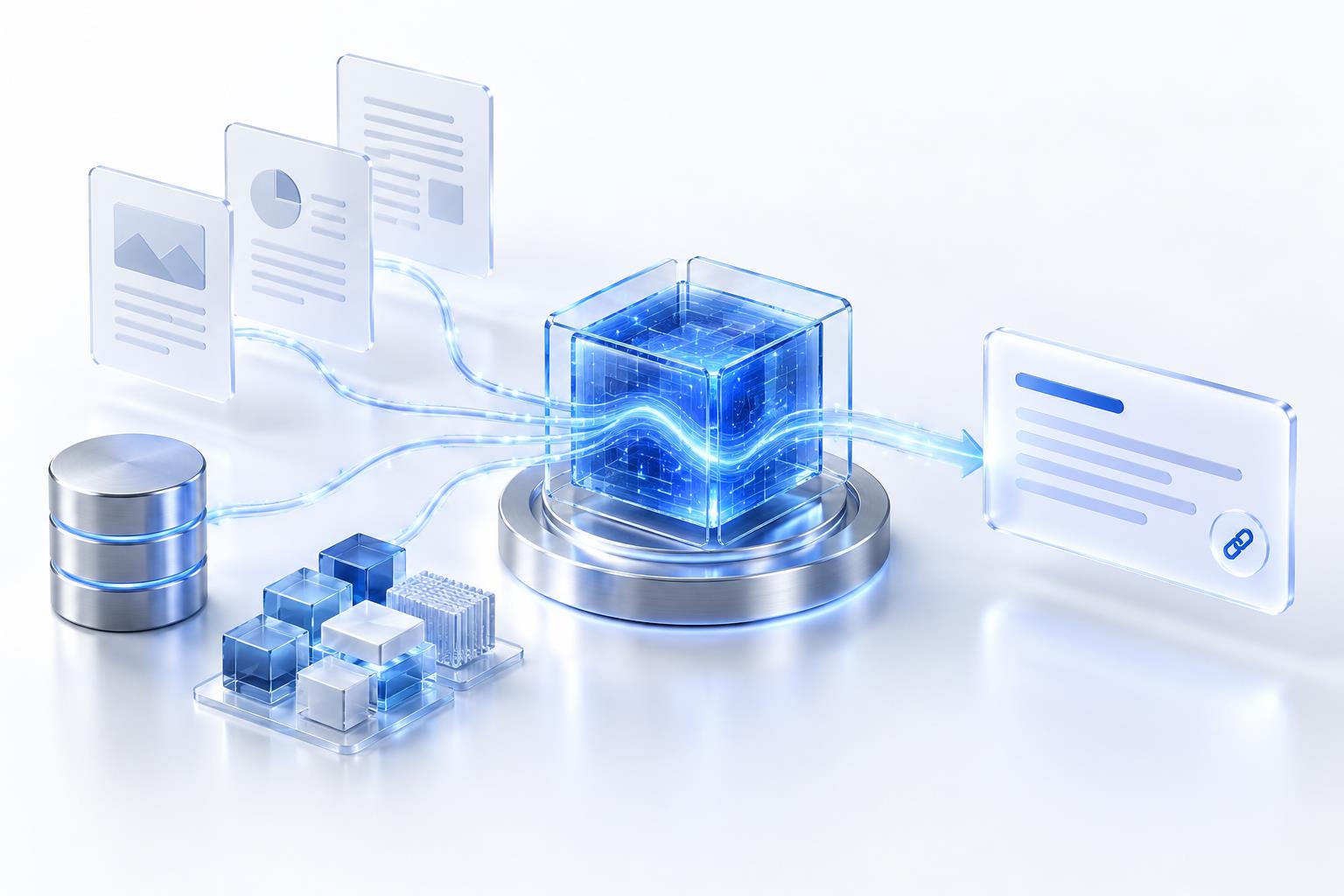
Organize scattered company data with Artificial Intelligence. Our RAG development services help your business get an intelligent solution for faster data retrieval from multiple sources - PDFs, contracts, emails, CRM, ERP, and more- and organize them into a searchable knowledge base for accurate answers. Let the team retrieve knowledge from data repositories 10x faster and get 99.99% accurate answers to their queries without AI hallucinations.
RAG systems limit your enterprise AI strictly to your specific company data, rules, and regulations. This ensures factually accurate answers, without any guesswork.
RAG empowers your employees to access straightforward answers to their queries without skimming through thousands of documents, ensuring faster resolution.
With RAG AI, organize scattered business data across isolated data points and create a connected knowledge base for your employees and customers.
Verify the generated answers with cited sources for transparent communication between the RAG systems and their authorized users.
From RAG implementation idea validation to secure RAG development aligned with your organizational needs, goals, objectives, and budget, we offer a complete suite of end-to-end services.
We help organizations identify the best use cases of RAG for their operations. Our senior AI engineers analyze business processes and build a personalized RAG application plan.
We tailor RAG applications fine-tuned to your organizational data silos. Our customised RAG systems help your team find factual answers grounded in the in-house knowledge base.
We integrate RAG systems into existing legacy systems such as ERPs, CRMs, HRMs, inventory management, and other kinds of system software.
We fine-tune renowned public LLMs such as ChatGPT, Gemini, Perplexity, and Claude on your business data, eliminating AI hallucinations and encouraging context-aware query answers.
For advanced requirements, we build autonomous and agentic RAG systems that can also cross-reference multiple documents and validate data against organizational rules.
As the company data grows, we continue to scale your RAG systems, providing end-to-end maintenance, upgrade, and performance optimization to keep your business AI-aligned.
Leverage the best of Retrieval Augmented Generation (RAG) technology with our guided use cases applicable to common business processes across varying business industries.
Check out some RAG success stories written by our AI engineers. Businesses across different industries transformed their disconnected data silos into instantly retrievable knowledge with Artificial Intelligence.
A New York-based legal firm (NDA-Protected) was spending over 40 business hours per week on manually retrieving legal precedents, retrieving approved clauses, and reviewing historical contracts. The manual retrieval was slowing down operations while also incurring data inaccuracies.
Our team unified the disconnected data silos, knowledge repositories, and internal documentation into a Retrieval-Augmented Generation (RAG) architecture. Our team also implemented Document AI features for a hyperautomated documentation process end-to-end.
A California-based event management business (NDA-Protected), handling a user base of over 1 million on its mobile app, was struggling with customer inquiries, booking assistance, service coordination requests, and fragmented access to business knowledge. Support teams were spending significant time manually retrieving information across systems before responding to customers.
We implemented the RAG solution that unified customer support knowledge, service documentation, event information, booking policies, and operational procedures. Our engineers designed intelligent documentation workflows for faster and more accurate documentation.
A Chicago-based accounting firm (NDA-Protected) was spending valuable business hours searching financial policies, retrieving audit documentation, validating historical accounting records, and preparing financial reports. Growing transaction volumes were increasing workload, delaying reporting cycles, and creating risks of manual errors.
Our AI engineers implemented a RAG solution that connected accounting procedures, audit records, tax guidelines, financial documentation, and reporting knowledge repositories into a single intelligent search and retrieval layer. For a hyperautomated experience, our team also implemented IDP and OCR technologies that further orchestrated the overall process.
Retrieve patient care protocols, clinical guidelines, treatment documentation, and medical knowledge repositories lightning fast with HIPAA-compliant RAG solutions.
Get instant access to lending policies, risk assessment frameworks, compliance documents, and customer databases with SOX and AML-aligned RAG architecture.
Accelerate policy servicing, claims investigation, underwriting research, and regulatory documentation retrieval with NAIC-compliant RAG systems.
Access lease agreements, property records, transaction documentation, tenant policies, and operational knowledge faster with FHA and RESPA-aligned RAG solutions.
Transform technical manuals, quality procedures, production documentation, and operational SOPs into searchable knowledge assets for the team with OSHA and ISO-compliant systems.
Access shipment documentation, vendor agreements, inventory procedures, and supply chain knowledge faster with SOC 2-compliant systems.
Deliver quick access to product catalogs, inventory policies, return procedures, customer support knowledge, and operational documentation with PCI-DSS compliant solutions.
Simplify contract analysis, legal research, clause discovery, case documentation retrieval, and regulatory knowledge management with ABA-aligned confidentiality standards.
Empower customer service and operations teams with instant access to service documentation, billing policies, troubleshooting procedures, and more with FCC-compliant RAG architecture.
Transform academic policies, learning resources, institutional documents, and student records into conversational AI experiences with FERPA-compliant RAG solutions.
Enable employees and HR teams to instantly retrieve onboarding documentation, payroll policies, employee handbooks, compliance guidelines, and workforce knowledge assets.
Access accounting procedures, tax regulations, audit documentation, financial policies, and compliance records superfast with IRS and SOX-aligned RAG implementation.
Retrieve reservation policies, guest service procedures, operational documents, loyalty program guidelines, and support knowledge instantly with PCI-DSS compliant RAG systems.
Empower your team with quick access to asset documentation, maintenance procedures, safety protocols, and regulatory reporting with NERC and EPA-aligned RAG solutions.
Transform project documentation, engineering specifications, safety procedures, and procurement records into context-aware AI experiences with OSHA-compliant RAG solutions.
Retrieve warranty documentation, service manuals, dealership procedures, technical specifications, and supplier knowledge repositories instantly with NHTSA-aligned solutions.
Access clinical documentation, research records, quality assurance procedures, regulatory guidelines, and product knowledge instantly with GxP-compliant solutions.
Improve citizen service delivery and internal operations through instant retrieval of policy documents, public records, and regulatory frameworks with FISMA-compliant architecture.
Transform editorial guidelines, content archives, publishing documents, advertising policies, and more into searchable intelligence systems with copyright governance-ready RAG solutions.
Help consultants retrieve proposals, project documentation, case studies, client deliverables, and organizational knowledge instantly with SOC 2-aligned intelligent solutions.
Our team builds grounded RAG systems fine-tuned to your organization’s private data using a systematic RAG development process. We make sure that a RAG solution aligns with your business needs and delivers a secure and scalable user journey.
Senior AI engineers gather your requirements and analyze your business operations.
Our team develops a personalized RAG implementation strategy aligned with your operations.
AI engineers develop an architecture blueprint, define the tech stack, and scope of work.
The RAG specialist AI developers start with the RAG feature development with agile methods.
Before and after RAG integration, our team thoroughly tests and optimizes the solution.
After deployment, our DevOps and Managed IT teams continue to scale the RAG system.
Our AI software engineers choose the most reliable and standard technology stack aligned with your data volume, RAG expectations, scalability goals, and low response latency. We choose a technology stack that ensures long-term maintainability and high data security.
Our RAG systems are designed for security, governance, access control, and regulatory compliance for handling sensitive business data such as business records, customer information, financial data, and regulated documents responsibly.

Complimentary Session. NDA-Assurance. Talk with RAG Experts, Not the Sales Team.
Complimentary Session. NDA-Assurance. Talk with RAG Experts, Not the Sales Team.