
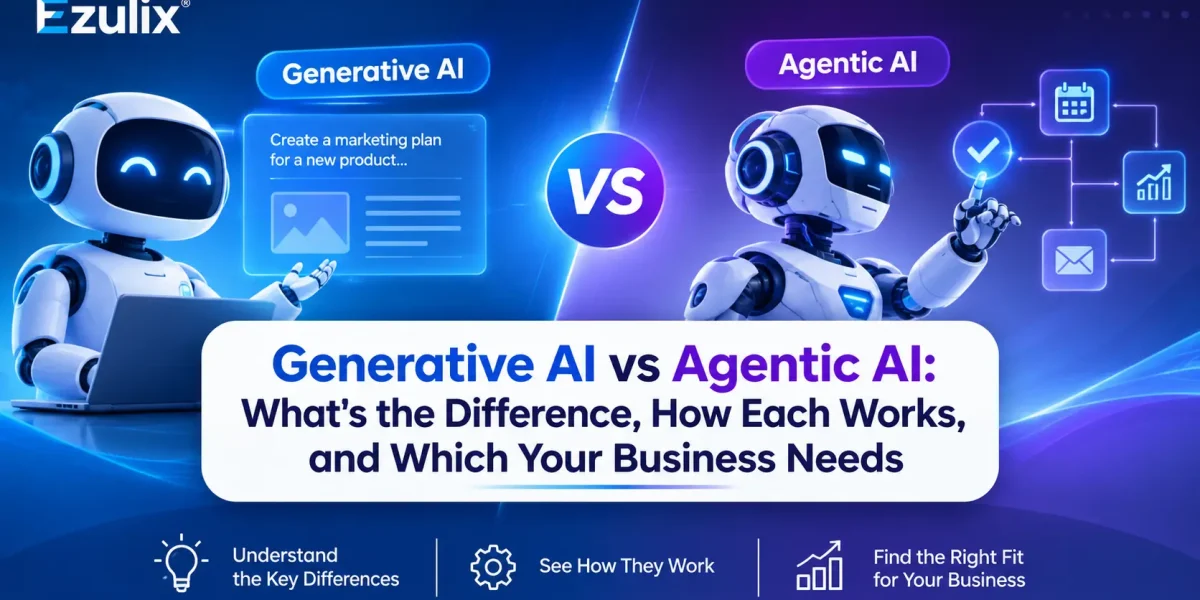
What Is Generative AI?

Generative AI is a category of artificial intelligence that produces new content by learning patterns from large amounts of existing data. A text model learns how words, sentences, and ideas usually fit together. An image model learns how visual elements relate to written descriptions. When you give it a prompt, it predicts and assembles an output that matches the patterns it learned.
Most AI tools people use daily fall into this category. They can draft an email, summarize a report, generate a product photo, write a Python function, or translate a contract into plain language. The common thread is that the model responds to an input and produces an output. Once it answers, the interaction is usually over unless you ask again.
How Generative Text Models Work
Large language models (LLMs) power most generative text tools. An LLM is trained to predict the next token, a small piece of text such as a word or part of a word, based on everything that came before it. The model sees enormous amounts of text during training, and it adjusts billions of internal values until its predictions become accurate. Repeated across that scale, this simple objective produces writing, summarizing, reasoning, and coding behavior that often looks surprisingly capable.
It is important to understand what this means in practice. The model does not look up answers in a database by default. It generates responses based on patterns it has learned. That is why it can write fluently about almost any topic, and also why it can produce confident mistakes.
What Generative AI Does Well
Generative AI excels at tasks where the goal is a finished piece of content. Its main strengths include:
- Speed: a first draft of an article, email, or product description appears in seconds.
- Versatility: the same tool can switch between formal reports, casual social posts, and technical documentation.
- Transformation: it can reshape existing material, such as turning meeting notes into an action list or a long report into a summary.
- Ideation: it can generate many options quickly, which helps with naming, headlines, and brainstorming.
What Generative AI Cannot Do Alone
A standard generative model does not act in the world. It cannot log into your email, check your calendar, update a spreadsheet, or book a flight unless it has been connected to tools and given a workflow to follow. Its job ends with the output. A human must review the result, decide what to do with it, and carry out any next steps.
This limitation is not a flaw. It is a design boundary, and it is one reason many organizations start with generative AI. The human stays in control of every action.
What Is Agentic AI?
Agentic AI refers to systems that work toward a goal over multiple steps with a degree of autonomy. Instead of answering one question and stopping, an agentic system breaks a goal into smaller tasks, decides which tools to use, carries out actions, observes the results, and adjusts its plan. For a deeper look at this design pattern, see our guide to agentic AI development.
Think of the difference this way. A generative model is like a skilled writer who waits for an assignment and delivers a draft. An agentic system is like a project coordinator who receives a goal, creates a plan, contacts the right people, tracks progress, and reports back when the job is done.
The Agentic Loop
Most agentic systems follow a repeating cycle, sometimes described as perceive, plan, act, and observe:
- Perceive: the agent takes in the goal and any relevant context, such as files, data, or messages.
- Plan: it breaks the goal into steps and decides what to do first.
- Act: it calls a tool, such as a search API, a database query, or a form submission.
- Observe: it reads the result and checks whether the step worked.
- Adjust: it updates the plan, retries a failed step, or asks a human for help if the situation is unclear.
The loop continues until the goal is complete or the agent reaches a stopping rule you have defined. This cycle is what separates agentic systems from single-turn generative tools.
The Four Components of an Agentic System

A typical agentic system includes four components:
- A goal: a clear objective, such as “research five competitors and draft a comparison table.”
- Reasoning and planning: the ability to break the goal into steps and decide what to do next.
- Tools: connections to search engines, databases, spreadsheets, APIs, or internal software.
- Memory and feedback: a way to track what has happened so far and correct mistakes.
Levels of Autonomy
Agentic AI is not all-or-nothing. Systems vary widely in how much they do without asking:
- Assisted: the agent suggests actions, and a person approves each one.
- Supervised: the agent completes routine steps, but pauses for approval at defined checkpoints.
- Autonomous with guardrails: the agent runs a full workflow within strict limits, such as spending caps, approved tools, and automatic alerts.
Most business deployments in practice sit in the first two categories. Full autonomy is reserved for low-risk, well-tested processes.
Generative AI vs Agentic AI: Key Differences
The table below summarizes the main differences. Use it as a quick reference when deciding which approach fits a task.
| Feature | Generative AI | Agentic AI |
|---|---|---|
| Primary purpose | Create content from a prompt | Achieve a goal through actions |
| Interaction style | Usually one prompt, one response | Multi-step and goal-driven |
| Autonomy | Low, waits for user input | Higher, plans and acts between inputs |
| Tool use | Optional and limited | Core to how it works |
| Memory | Usually limited to the conversation | Often tracks task state and progress |
| Feedback loop | Minimal | Observes results and adjusts |
| Typical example | Writing a blog draft | Researching, drafting, publishing, and monitoring a blog campaign |
| Main risk | Inaccurate or unverified output | Unintended actions and errors that compound |
| Human role | Reviews and uses the output | Sets goals, sets limits, and approves key actions |
The simplest way to remember the difference: generative AI answers, while agentic AI acts. That distinction matters because action carries more risk and requires stronger guardrails.
A Side-by-Side Example
Abstract definitions become clearer with a concrete task. Imagine a marketing manager who needs a competitor pricing report.
With generative AI alone: The manager pastes competitor names and asks the tool to write a pricing comparison. The model produces a plausible-looking table based on what it learned during training. The problem is that the prices may be outdated, and the model may invent figures it does not actually know. The manager must check every number manually, which takes time.
With an agentic workflow: The manager sets a goal: “Compare current pricing for these five competitors and flag any changes since last month.” The agent searches each competitor’s pricing page, extracts the plans and prices, compares them with last month’s saved data, writes a summary using a generative model, and creates a spreadsheet. If a page cannot be read or a price looks unusual, the agent flags it for human review rather than guessing.
The generative model still writes the summary, but the agent handles the research, comparison, and follow-up. That combination is the core of the difference. Notice also that the agentic version is only trustworthy because it includes a review step for unclear results.
Is ChatGPT Generative AI or Agentic AI?
ChatGPT is primarily a generative AI product. At its core, it uses a large language model to generate text in response to prompts, which makes it generative by design.
ChatGPT also includes features that behave in agentic ways. When it browses the web for current information, runs code to analyze a file, or completes a multi-step task using connected tools, it goes beyond simple text generation. In those moments, it operates in an agentic pattern, using tools to gather information and produce a result.
So the accurate answer is that ChatGPT is generative AI at its foundation, with agentic capabilities available through specific features. Whether a given session counts as agentic depends on how you use it:
- A single question about history is generative work.
- Uploading a spreadsheet and asking the tool to clean the data, run calculations, and produce a chart involves tool use and multiple steps, which is closer to agentic work.
- Asking it to research five competitors, compile the results, and flag gaps is also agentic in nature, though you still review and act on the output yourself.
This nuance matters for businesses and content creators. Calling every AI tool “agentic” overstates what most products do, while calling them all “generative” understates what newer systems can accomplish. The more accurate statement is that ChatGPT is a generative product that can be used in agentic ways.
Is ChatGPT an Agent or an LLM?
ChatGPT is built on one or more large language models, so the simplest answer is that it is an application that uses an LLM. The model provides language understanding and generation. The surrounding product adds the interface, memory features, safety layers, and tool connections.
An LLM on its own is a model. It takes text in and produces text out. It does not browse the web, remember your past chats, or run code by itself. ChatGPT, as a product, combines the model with those additional components.
Whether that combined product counts as an “agent” depends on your definition. If an agent must pursue goals using tools with some autonomy, certain ChatGPT modes qualify in limited ways. If an agent must act independently over long periods with minimal supervision, most everyday uses do not qualify. Most people using ChatGPT are working with it interactively, step by step, which is a useful and common pattern but not fully autonomous.
A helpful way to explain this to readers is to separate three layers:
- The model: the LLM, which handles language.
- The product: ChatGPT, which combines the model with an interface, memory, and tools.
- The agentic workflow: the specific task the system completes using planning, tools, and feedback.
Each layer shapes the final experience. When someone asks whether ChatGPT is “an agent or an LLM,” the honest answer is that it is a product built on an LLM, and its agentic behavior depends on the features in use.
Is There a Difference Between AI and Agentic AI?
Yes. “AI” is a broad field that includes machine learning, computer vision, robotics, natural language processing, expert systems, and more. Agentic AI is a narrower concept within that field. It describes systems designed to act toward goals.
A spam filter uses AI. A product recommendation engine uses AI. Neither is usually considered agentic, because neither plans a multi-step course of action or uses tools to pursue an objective. A system that reads your inbox, identifies a meeting request, checks your calendar, proposes three time slots, and drafts a reply for your approval is much closer to agentic AI.
Every agentic system is AI, but most AI systems are not agentic. The word “agentic” points to the ability to pursue goals, not just to process data or generate outputs. For example, predictive models that forecast demand are valuable AI, yet they only produce predictions. A system that uses those forecasts to adjust orders, notify suppliers, and report exceptions starts to look agentic.
The 3 Types of AI
People searching “the 3 types of AI” usually encounter two common frameworks, and the answer depends on which one you use. Name your framework clearly, because sources organize the field differently.
Framework 1: Based on capability
- Narrow AI (weak AI): designed for a specific task, such as image recognition, translation, or chess. Nearly every AI system in use today falls into this category, including ChatGPT and most agentic tools.
- General AI (strong AI): a hypothetical system that could perform any intellectual task a human can. It does not exist today, and researchers disagree about whether or when it will.
- Super AI: a theoretical system that would surpass human intelligence across all domains. This remains speculative.
Framework 2: Based on functionality
- Reactive machines: systems that respond to inputs without memory of past interactions, such as early chess programs.
- Limited memory: systems that use recent data to inform decisions. Most modern AI, including LLM-based tools, works this way.
- Theory of mind: systems that could understand human emotions and intentions. This is still a research goal.
- Self-aware AI: systems with consciousness and self-understanding. This is theoretical.
For most business readers, the capability-based framework is the clearest starting point. It shows that today’s generative and agentic tools are all narrow AI, even when they seem impressively broad. When you publish content on this topic, state which framework you are using at the start of the section. That clarity builds trust and helps readers who encounter other sources.
Common Myths About Generative and Agentic AI

Misunderstandings spread quickly in this space. Clearing them up helps readers make better decisions.
Myth: Any chatbot is agentic AI.
Not necessarily. A chatbot that only answers questions from a fixed script is not agentic. Agentic behavior requires planning, tool use, and actions toward a goal.
Myth: Agentic AI means the system works without any human involvement.
Most practical systems include human checkpoints. Full autonomy is rare and usually limited to low-risk, well-tested tasks.
Myth: Generative AI always gives accurate information.
Generative models can produce fluent but incorrect content. Verification is still necessary, especially for statistics, legal details, medical information, and citations.
Myth: Agentic AI is only for large enterprises.
Small teams can use simple agent workflows for tasks such as lead follow-up, content research, or ticket routing. The scope should match the size of the process and the team’s ability to monitor it.
Myth: More autonomy is always better.
Autonomy increases both value and risk. The right level depends on how costly a mistake would be and how reliably the process can be monitored.
How Generative and Agentic AI Work Together
The two approaches are not competitors. In most real systems, generative AI is one component inside an agentic workflow. The agent uses a language model to reason, write messages, summarize results, or generate code, while the agent framework handles planning, tool calls, and task tracking.
Complex work often involves several specialized agents coordinating with each other. Designing those interactions is the focus of multi-agent AI systems, where each agent handles a defined role and passes results forward. For example, one agent gathers data, another drafts an analysis, and a third checks the output against business rules before a person reviews it.
Consider a practical example: planning a business trip. A generative tool can write an itinerary if you describe your needs. An agentic system goes further. It checks your calendar for open dates, searches flight options that match your budget, compares prices, holds a reservation pending your approval, adds the trip to your calendar, and drafts an email to your manager. The language model writes the messages and summaries, but the agent coordinates the full sequence.
Content teams see the same pattern. A generative model can draft a blog post from an outline. An agentic workflow can take a target keyword, pull search data, analyze competitor pages, create a content brief, draft the article, check it against a checklist, and flag sections that need human review. The human’s role shifts from writing every sentence to setting strategy, judging quality, and making final decisions.
Practical Use Cases
Generative AI use cases
- Drafting marketing copy, product descriptions, and email sequences
- Summarizing long reports, research papers, and meeting transcripts
- Creating images, illustrations, and presentation visuals
- Writing and explaining code snippets, and reviewing code for common issues
- Translating content and adapting tone for different audiences
- Powering conversational interfaces through AI chatbot development
- Generating training materials, quizzes, and onboarding guides
Agentic AI use cases
- Monitoring search rankings and flagging significant changes
- Handling customer support tickets from intake to resolution, with escalation rules, as an AI customer support agent
- Running multi-step research projects that compile findings into a structured report, similar to an AI research agent
- Managing recurring processes such as invoice handling or lead qualification through AI workflow automation
- Assisting staff with drafting, lookups, and task execution through an AI copilot
- Reconciling data across systems and flagging mismatches for review
The value difference is significant. Generative tools save time on individual tasks. Agentic systems reduce the number of handoffs between tasks, and handoffs are often where the most time is lost. When a process involves five people and three software tools, removing even a few handoffs can change how quickly work moves.
Risks and Limitations to Consider
Both approaches have limitations, and agentic systems add risks because they can take actions.
Generative AI risks
- Hallucinations: models can produce confident but incorrect statements, including invented citations and statistics. Always verify figures and sources before publishing.
- Outdated information: models have training cutoffs and may not know recent events unless they search the web or access current data.
- Bias and quality variation: outputs reflect patterns in training data and can vary in quality from one run to the next.
- Privacy exposure: pasting confidential data into a tool without checking its data policies can create compliance problems.
Agentic AI risks
- Compounding errors: a mistake in step one can carry through every later step. An agent that misreads a product code may update the wrong inventory records, then send incorrect notices based on them.
- Unintended actions: an agent with access to email, payments, or databases can cause real damage if it misreads a goal. Designing safe boundaries for autonomous AI agents is one of the most important parts of deployment.
- Security exposure: connecting tools creates new attack surfaces, including prompt injection, where malicious text in a web page or document tries to redirect the agent.
- Accountability gaps: when an agent makes a decision, it can be unclear who is responsible for the result. Define ownership before deployment.
- Cost overruns: agents that loop through many tool calls can consume more compute and API spend than expected. Set limits on steps and spending.
Guardrails That Reduce These Risks
The practical response is layered oversight:
- Limit permissions to the minimum an agent needs. Read-only access is safer than write access when the task allows it.
- Require approval for high-stakes actions such as payments, publishing, deleting records, or messages to customers.
- Set step and spend limits so a runaway loop stops automatically.
- Log every action so you can audit what happened and why.
- Test on low-risk tasks before expanding to important processes.
- Review regularly. Check logs, sample outputs, and error rates on a schedule rather than only after a problem appears.
How to Choose the Right Approach
Start with the task, not the technology. Ask these four questions:
- Is the task a single output or a sequence of actions? If it is one output, such as a paragraph or an image, generative AI is usually enough. If it requires multiple steps across tools, consider an agentic approach.
- How much does a mistake cost? Low-stakes tasks can tolerate more autonomy. High-stakes tasks need review checkpoints before any irreversible action.
- How often does the task repeat? Repetitive, rules-based workflows are strong candidates for agents. One-off creative work usually suits generative tools.
- What tools and data does the task require? If the work depends on live data, internal systems, or external services, you need tool integration, which points toward agentic design. If it depends on your own documents, you may also need a retrieval layer.
A quick decision guide:
- Choose generative AI when you need drafts, summaries, ideas, translations, or explanations, and a person will take the next step.
- Choose agentic AI when you need a repeatable process completed across several tools, with clear rules and monitoring.
- Combine both when the process needs generated content inside a larger workflow, which is the most common pattern in practice.
Connecting AI to existing data is often the hardest step. Retrieval-augmented generation (RAG) development is one proven way to ground answers in your own documents, so the system references your policies, product details, or knowledge base rather than relying only on general training.
If you are unsure where to begin, AI consulting services can help map your processes to the right approach before you commit budget.
A Step-by-Step Adoption Roadmap
Organizations that succeed with AI usually move in stages. This roadmap works for small teams and larger companies alike.
Step 1: Identify three to five target processes. Look for tasks that are frequent, time-consuming, and well understood. Examples include writing first drafts, summarizing customer feedback, or routing support requests.
Step 2: Start with generative AI for drafting and analysis. Use a tool to speed up individual tasks. Write clear prompts, define what good output looks like, and keep a human reviewer in place. This stage builds familiarity and reveals common errors.
Step 3: Document the workflow. Before adding automation, write down each step, the inputs and outputs, who approves what, and where delays occur. This documentation becomes the blueprint for any agent you build later.
Step 4: Pilot one agentic workflow on low-risk work. Choose a process where mistakes are easy to catch and reverse. Set clear goals, permissions, step limits, and approval points. Run the pilot for several weeks and track accuracy, time saved, and exceptions.
Step 5: Measure and adjust. Compare results with the manual baseline. Track error rates, human review time, cost per task, and user satisfaction. Adjust prompts, tools, and rules based on what you find.
Step 6: Expand carefully. Add new workflows only after the first one runs reliably. Increase autonomy gradually as confidence grows, and keep audit logs in place throughout.
Step 7: Build governance. Assign an owner for each agent, define escalation paths, and schedule periodic reviews. Governance is what keeps useful systems safe as they grow.
For teams that want outside help with this process, AI automation services can support the design, build, and monitoring of workflows, while enterprise AI solutions address larger-scale deployments with stricter security and compliance needs.
Glossary
Agent: a system that pursues a goal by planning, using tools, and acting on results.
Agentic AI: AI systems designed to work toward goals through multi-step planning, tool use, and feedback.
Generative AI: AI that creates new content, such as text, images, code, or audio, based on patterns learned from data.
Hallucination: a confident but incorrect output from an AI model, often including invented facts or sources.
Large language model (LLM): a model trained on large amounts of text to predict and generate language.
Human-in-the-loop: a design in which a person reviews or approves key steps before an AI system continues.
Prompt: the instruction or input you give to a generative model.
Prompt injection: an attack in which malicious text tries to override an AI system’s instructions.
Retrieval-augmented generation (RAG): a method that retrieves relevant documents and supplies them to a model so its answers rely on specific sources.
Tool use: an AI system’s ability to call external functions, such as search, databases, or APIs.
Frequently Asked Questions
What is the simplest difference between generative AI and agentic AI?
Generative AI creates content in response to a prompt. Agentic AI pursues a goal by planning, using tools, and taking actions across multiple steps.
Is agentic AI the same as artificial general intelligence?
No. Agentic AI describes systems that act toward goals using current technology. Artificial general intelligence would match or exceed human ability across most intellectual tasks, and it does not exist yet.
Can generative AI become agentic?
Yes. Adding planning, tool access, memory, and a feedback loop to a generative model can make it agentic. Many current products combine both approaches.
Is ChatGPT agentic AI?
ChatGPT is primarily generative AI. It shows agentic behavior when it uses browsing, code execution, or other tools to complete multi-step tasks, but most everyday use is interactive generation.
Is ChatGPT an AI agent or an LLM?
ChatGPT is a product built on large language models. The LLM provides the language capability, and the product adds features such as tools and memory. Whether it counts as an agent depends on which features you use.
Are AI agents safe to use for business tasks?
They can be, with appropriate safeguards. Limit permissions, require approval for high-impact actions, set step and spending limits, log all activity, and test workflows on low-risk tasks before expanding them.
Which is better for small businesses, generative or agentic AI?
Most small businesses benefit from generative AI first, for writing, summarizing, and analysis. Agentic workflows make sense once a repeatable process is clearly defined and someone is responsible for monitoring it.
What is the difference between AI and agentic AI?
AI is the broad field of systems that perform intelligent tasks. Agentic AI is a narrower category of AI systems designed to plan and act toward goals using tools.
What are the 3 types of AI?
It depends on the framework. By capability, they are narrow AI, general AI, and super AI. By functionality, they are reactive machines, limited memory, and theory of mind, with self-aware AI as a further theoretical category. Today’s tools are all narrow AI.
Do I need to build my own agent to benefit from agentic AI?
Not always. Many existing software platforms include agent-like features. Building custom agents makes sense when your processes are unique or when off-the-shelf tools cannot connect to your systems.
How do I know if a process is ready for an agent?
The process should be frequent, well documented, and tolerant of review checkpoints. If you cannot describe the steps clearly, document them first.
Conclusion
Generative AI and agentic AI are related but different. Generative AI produces content in response to prompts, and it powers most of the AI tools people use today. Agentic AI pursues goals through planning, tool use, and action, which makes it more powerful and more demanding to manage.
The most effective approach for most organizations is to start with generative AI for drafting and analysis, document your workflows, and then introduce agentic systems for repeatable processes with clear guardrails. Keep humans responsible for decisions that carry real consequences.
If you are choosing tools, start with the task and its risk level. If you are creating content, keep explanations clear, direct, and grounded in examples.
Ready to move from research to implementation? Book a free AI strategy call with the Ezulix team to discuss which generative or agentic approach fits your business. For broader options, explore our AI development services.
